South Korea Long-Term Visa Types — Your 2026 Guide
You have a job offer in Seoul, or maybe you just finished a Korean language program and want to stay longer. Either way, you are staring at a wall of visa codes — F-2, F-5, E-7, D-10 — and none of them make immediate sense. The Korean immigration system is thorough, but it was not designed to be intuitive for outsiders, and one wrong assumption about eligibility can cost you months.
This article breaks down the most common long-term visa options in South Korea as of March 2026, including the latest policy changes that took effect in February. You will find clear eligibility requirements, a side-by-side comparison of the most common visa types, and the practical steps to actually apply — so you can figure out which path fits your situation before you book that appointment at immigration.
How Korean Visa Categories Work
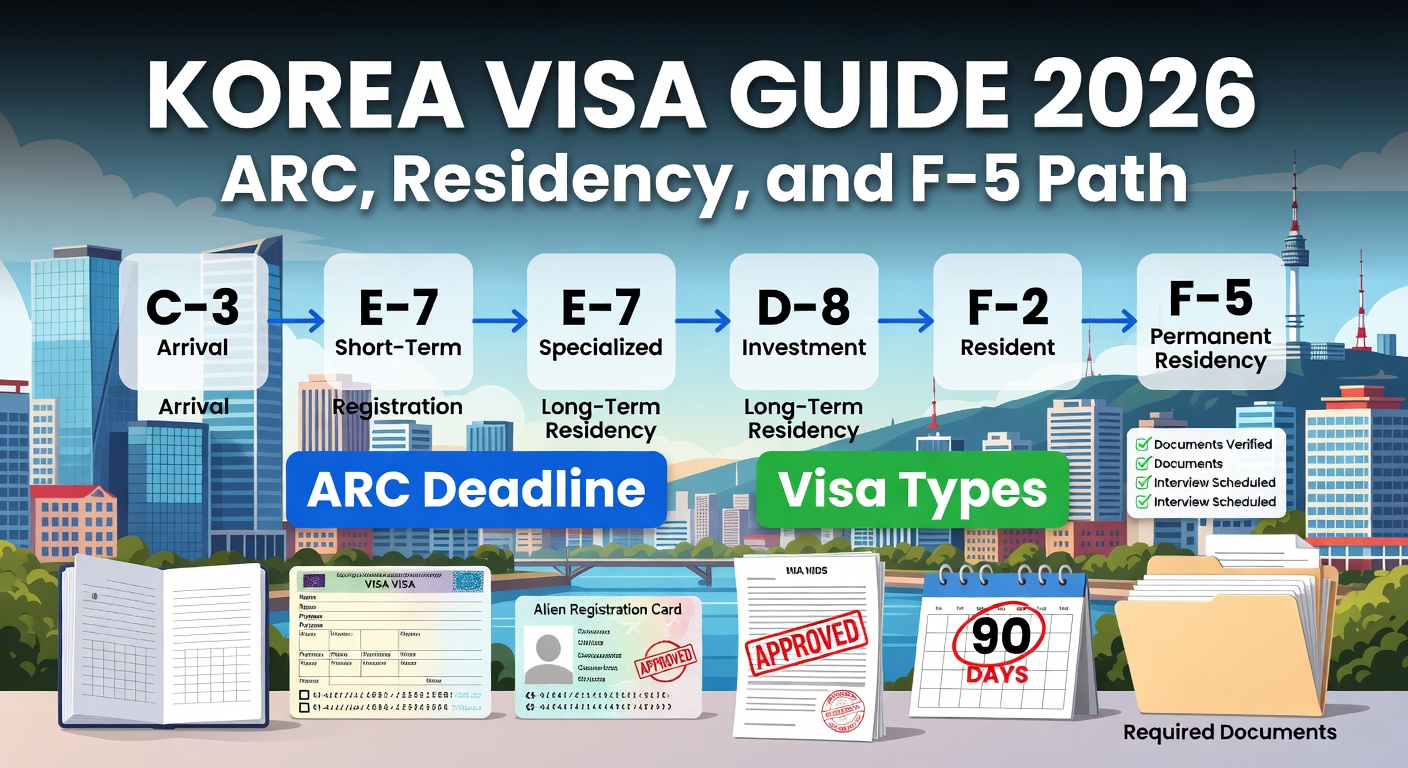
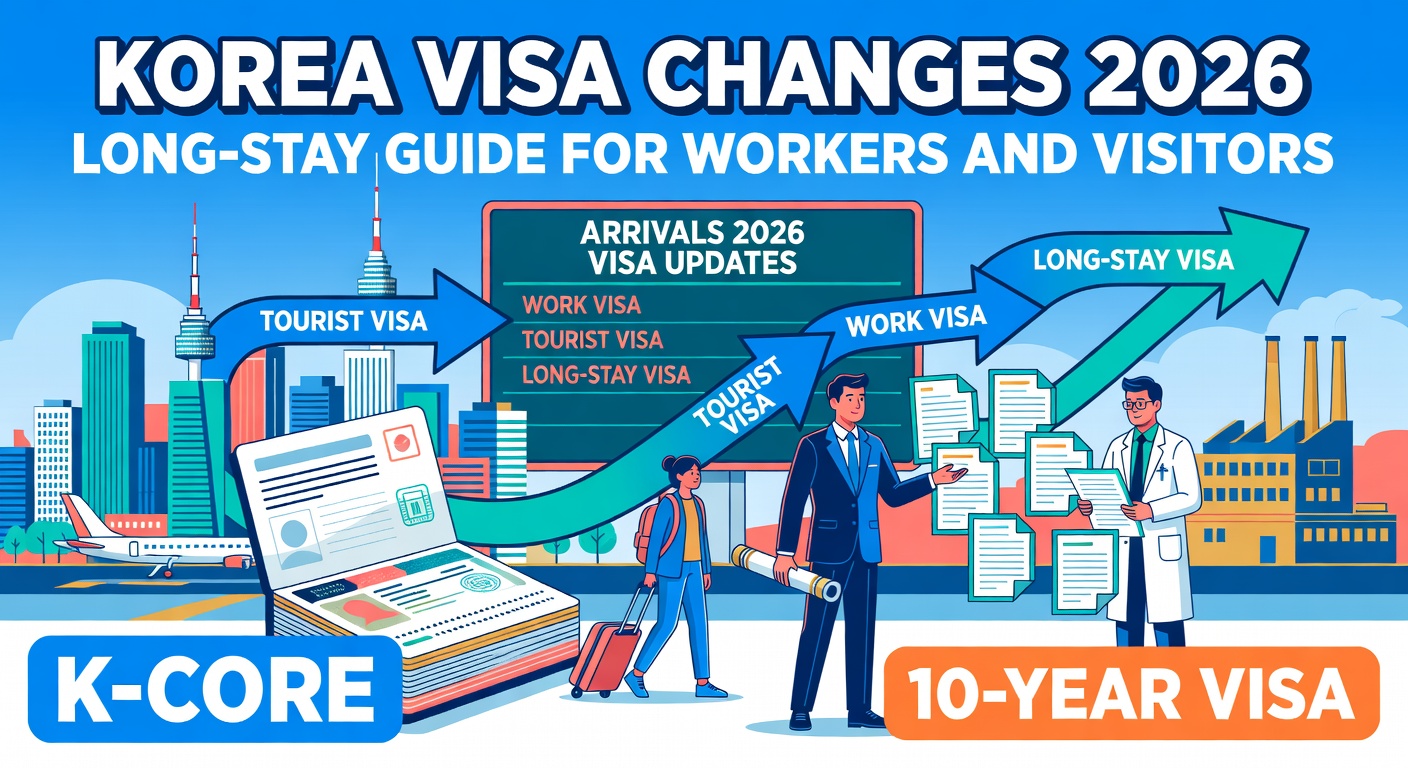
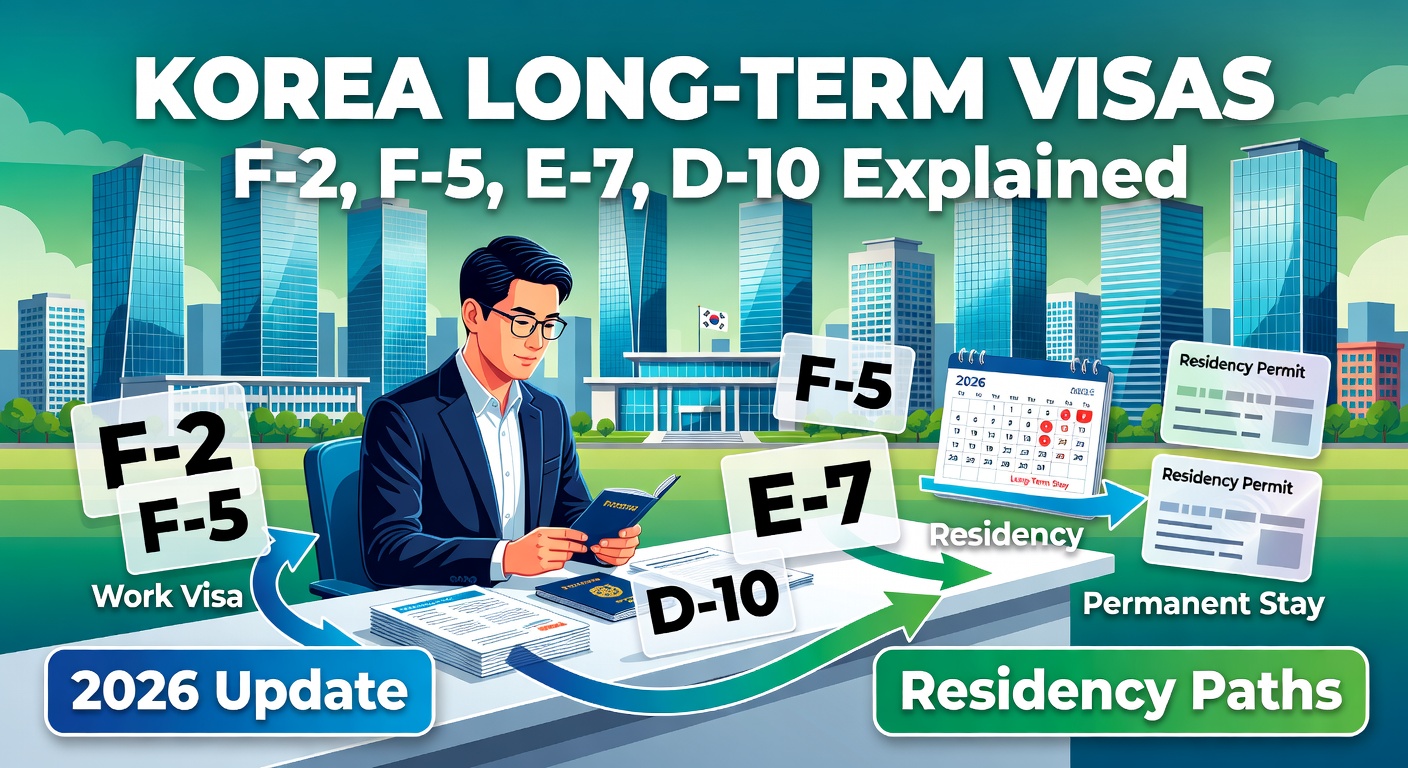
South Korea classifies visas into letter-number codes managed by the Ministry of Justice's Korea Immigration Service. Short-term visas fall under the C series (like C-3 for tourism, capped at 90 days). Long-term visas — the ones that let you actually build a life here — fall under the D, E, and F series, with stays ranging from one to five years, and in one case, indefinitely.
The key distinction many people find confusing is between sojourn status and the visa sticker itself. Your visa gets you into the country, but your sojourn status (체류자격) determines what you can do while you are here — work, study, invest, or simply reside. Changing your sojourn status after arrival is possible through the Hi Korea online system, but it is a separate process from your initial visa application.
As of 2026, roughly 2.5 million foreign nationals are registered as residents in South Korea. The system is well-established, but the rules shift regularly — and February 2026 brought several notable changes.
The Major Long-Term Visa Types Explained
F-2: Long-Term Residency
The F-2 visa is the workhorse of long-term living in Korea. It covers several sub-categories, but the most relevant for foreign professionals is the F-2-7 points-based system. This visa grants up to five years of residence with relatively free employment rights.
To qualify for the standard F-2, you generally need five or more years of continuous residence in Korea, a clean criminal record, proof of financial stability (income at roughly twice the GNI per capita, per Ministry of Justice guidelines), and completion of the Korea Immigration and Integration Program (KIIP, 사회통합프로그램) to at least level 4. The points system under F-2-7 scores you on age, education, Korean language ability, income, and other factors.
A common point of confusion: the F-2 does not mean unlimited work permission. Some sub-categories restrict which industries you can work in, and the specific conditions depend on which F-2 variant you hold. Always confirm your permitted activities with your local immigration office.
New for 2026: The F-2-R regional visa has been restructured to encourage settlement in population-declining areas. If you are considering life outside Seoul or Busan, this variant may offer a faster path to residency.
🔗 F-2 Visa Requirements (IMMIKOREA)
F-5: Permanent Residency
The F-5 is what most people think of as a green card equivalent. It grants indefinite stay with almost no employment restrictions. Getting it, however, is the hardest immigration milestone in Korea.
Standard F-5 requirements include having held F-2 status for a qualifying period, meeting income thresholds, passing the KIIP program, and demonstrating consistent tax compliance. There are special tracks for high-income earners, investors meeting substantial capital thresholds, and individuals with exceptional skills.
The biggest stumbling block people encounter with the F-5 is the income documentation. Korea's GNI-based thresholds change annually, and the 2026 GNI figure had not been officially published at the time of writing. If you are planning to apply, check the latest announcement from the Ministry of Justice before assembling your paperwork.
New for 2026: The K-STAR visa track now offers a fast-track to permanent residency for international STEM students graduating from Korean universities. If you are studying engineering or natural sciences at a Korean institution, this could shave years off the typical F-2 → F-5 pathway.
🔗 2026 Immigration Policy Changes (PROK)
E-7: Skilled Employment
The E-7 visa is the primary work visa for professionals. It covers a wide range of specialized occupations — from IT engineers and translators to chefs and industrial designers — and is typically sponsored by your employer.
Eligibility depends on your field. You need either a relevant bachelor's degree plus work experience, or extensive professional experience in lieu of formal education. Your employer must also meet minimum salary thresholds, which were raised in February 2026. The new minimum for E-7-1 (professional jobs) is KRW 31.12 million annually, up from KRW 28.67 million in 2025.
Where people most often get tripped up with the E-7 is the job change process. Unlike the F-2, you cannot freely switch employers. Changing jobs requires permission from immigration, and your new employer must file paperwork on your behalf. If you leave your job before securing a transfer, you may find yourself in a difficult legal gray area.
🔗 2026 E-7 Salary Requirements (Korea Immigration Service)
D-10: Job Seeker Visa
The D-10 is a bridge visa designed for people who have completed studies or training in Korea and need time to find employment. It lasts six months to one year and allows limited internship work.
This visa is most useful for recent graduates of Korean universities who want to transition to an E-7. The catch is that your job search activities must be documented, and the visa does not convert automatically — you still need to go through the full E-7 application once you land a position.
F-6: Marriage Migration
If you are married to a Korean citizen, the F-6 grants up to three years of residence. It is one of the more straightforward long-term visas in terms of eligibility, but the documentation requirements are extensive. Immigration will verify the legitimacy of your marriage, your spouse's ability to support the household, and your basic Korean language or cultural knowledge.
Comparing Your Options at a Glance
| Visa | Max Duration | Work Rights | Best For | Key Requirement |
|---|---|---|---|---|
| F-2 (Residency) | 5 years | Mostly unrestricted | Long-term residents, investors | 5+ years in Korea, KIIP level 4, income proof |
| F-5 (Permanent) | Unlimited | Fully unrestricted | Those committed to staying indefinitely | F-2 history, high income, full KIIP |
| E-7 (Skilled Work) | 3 years | Employer-specific | Professionals with a job offer | Degree + employer sponsorship, min. salary KRW 31.12M |
| D-10 (Job Seeker) | 6 months–1 year | Internship only | Recent graduates in Korea | Completed Korean degree/training |
| F-6 (Marriage) | 3 years | Unrestricted | Spouses of Korean citizens | Verified marriage, spouse income |
How the Application Process Works
Regardless of which visa you are applying for, the general flow is the same. You can apply at a Korean embassy or consulate abroad, or — if you are already in Korea on a different visa — apply for a status change through the Hi Korea (하이코리아) online portal or by visiting your local immigration office in person.
After registration, keep two deadlines in mind: report any change of address within 15 days, and apply for visa extensions at least four months before expiry. Missing your renewal window is one of the most common and costly mistakes — overstaying even by a day technically counts as illegal residence and can affect future applications.
What 2026 Changed
February 2026 brought three policy updates worth knowing about.
E-7 salary floor increased. The minimum annual salary for E-7-1 professional positions rose to KRW 31.12 million, up from KRW 28.67 million in 2025. If your employer's offer falls below this threshold, the visa application will be rejected regardless of your qualifications. According to the Korea Immigration Service's official announcement, this applies to all new E-7 applications filed from February 1, 2026 onward.
K-STAR visa track launched. This new fast-track targets international students in STEM fields at Korean universities. Qualifying graduates can move through the residency pipeline toward F-5 permanent status significantly faster than through the traditional route. Details are still being refined, so check with your university's international office for the latest eligibility criteria.
F-2-R regional visa restructured. Korea is actively trying to attract foreign residents to regions experiencing population decline. The revamped F-2-R offers more favorable conditions — including potentially lower income thresholds — for those willing to settle outside major metropolitan areas.
The Typical Progression Path
Most foreign professionals in Korea follow a predictable trajectory: enter on an E-7 (or sometimes D-2 student visa), build up residence time, transition to F-2 once they qualify, and eventually apply for F-5 if they plan to stay permanently.
This is not the only route. Marriage visa holders (F-6) can transition to F-5 after meeting residency and integration requirements. Investors with substantial capital can sometimes go directly to F-2 or F-5 through investment immigration programs. And the new K-STAR track offers a compressed timeline for STEM graduates.
The part that catches many people off guard is KIIP (Korea Immigration and Integration Program, 사회통합프로그램). This government-run program teaches Korean language and culture, and completing it is either required or gives significant bonus points for most long-term visa applications. The program has five levels, and reaching at least level 4 is typically necessary for F-2 eligibility. Classes are free but fill up quickly — registering early is strongly advisable.
Deciding Which Visa Fits Your Situation
The right visa depends entirely on where you are in your Korea journey. If you have a job offer from a Korean company, the E-7 is your starting point — your employer handles most of the heavy lifting. If you have already been in Korea for several years and want more freedom, the F-2 points system is likely your next step. If Korea is your permanent home, the F-5 is the end goal.
For people just starting to explore the idea of living in Korea, be realistic about timelines. Moving from a first E-7 visa to permanent F-5 status typically takes seven to ten years, factoring in the required residence periods, KIIP completion, and processing times. The new K-STAR and F-2-R pathways may shorten this for specific groups, but for most people, building a life in Korea through the visa system is a long-term commitment.
One final note: Korean immigration policy changes more frequently than many people expect. Income thresholds, points criteria, and even entire visa sub-categories can shift from year to year. The official Hi Korea website and your local immigration office are the only fully reliable sources for current requirements. Online forums and even this article should be treated as starting points, not final answers.
🔗 Korea Immigration Service (Hi Korea)
Conclusion
Choosing the right long-term visa for South Korea comes down to three things: your current situation, your employment status, and how long you plan to stay. The E-7 gets professionals in the door, the F-2 provides stability and flexibility, and the F-5 is the permanent commitment. With the 2026 policy updates — particularly the K-STAR track and regional F-2-R restructuring — there are now more pathways than before, especially for STEM graduates and those willing to live outside Seoul.
Start by identifying which visa category matches your situation using the comparison table above. Then visit Hi Korea to confirm the current document requirements for that specific visa. Book your immigration office appointment early, prepare your documents carefully (especially name matching and financial records), and do not wait until the last minute to apply for extensions. The system rewards preparation.
Frequently Asked Questions
Q. What is the minimum salary for an E-7 work visa in South Korea in 2026?
The minimum annual salary for E-7-1 professional positions is KRW 31.12 million as of February 2026, raised from KRW 28.67 million the previous year. This threshold applies to all new E-7 applications and must be met by your employer's contract offer.
Q. How long does it take to get permanent residency in South Korea?
For most foreign professionals, the path from initial work visa to F-5 permanent residency takes roughly seven to ten years. This includes building up the required years of residence, completing KIIP, and meeting income thresholds. The new K-STAR track may shorten this for qualifying STEM graduates.
Q. Can I change employers on an E-7 visa in Korea?
Yes, but you need permission from immigration before switching jobs. Your new employer must file a workplace change application on your behalf, and the new position must still meet E-7 eligibility requirements. Leaving your job without securing a transfer approval first can jeopardize your visa status.
Q. What is KIIP and do I need it for a long-term visa?
KIIP (Korea Immigration and Integration Program) is a free government program covering Korean language and culture. Completing it to at least level 4 is effectively required for F-2 residency and gives significant points toward F-5 permanent residency. Classes fill up fast, so register through the SOCINET website as early as possible.
Q. What happens if my visa expires before I apply for an extension?
Overstaying your visa — even by one day — is classified as illegal residence in South Korea. This can result in fines, deportation, and a re-entry ban that affects future visa applications. Korean immigration recommends applying for extensions at least four months before your current visa expires.
Recommended Posts
- Cheap Housing in Seoul Near Subway — Expat Options Compared
- Korea Visa for Foreigners — Your 2026 Residency Guide
- Jeonse vs Monthly Rent in Korea — Compared for Foreigners (2026)
- Korea Visa for Foreigners 2026 — Your Complete Long-Stay Guide
- First Month in Korea as a Foreigner — Your Complete Setup Checklist
IT Engineer · Content Creator
Practical guides based on official sources — simple and actionable.
View all posts →