Seoul Cost of Living 2026 — Monthly Budget Guide for Foreigners
You just got the job offer, the university acceptance letter, or the remote work setup that finally makes Seoul real. Now comes the question that keeps you scrolling at 2 a.m.: how much money do you actually need each month to live here without constantly stressing about your bank balance?
This article breaks down the real monthly costs of living in Seoul in 2026 — rent by housing type, food by eating style, utilities, transport, insurance, and the hidden extras that most budget guides skip. Every figure here reflects March 2026 pricing from multiple cost-of-living databases and expat community reports, with Korean won amounts and approximate USD conversions based on a rate of around 1,300 KRW per dollar — treat the dollar figures as rough anchors, since the rate can swing meaningfully.
How Much Seoul Actually Costs: The Big Picture
The short answer most expats land on: plan for ₩1.5 to ₩2.5 million per month all-in (roughly $1,150–$1,920 USD), depending on your housing choice and lifestyle. That range covers a single person renting their own place, eating a mix of home-cooked and restaurant meals, using public transit, and having a basic social life.
Where people commonly get tripped up is mixing "excluding rent" and "including rent" numbers without realizing it. You will see figures like "₩1 million is enough" floating around expat forums — that is usually excluding rent, which can easily add another ₩700,000–1,150,000 on its own. According to Numbeo's March 2026 Seoul data and LivingCostIndex, a single person's monthly costs excluding rent average around ₩1.3–2 million, while rent for a one-room adds ₩700,000–1,150,000 on top of that.
The three lifestyle tiers most foreigners fall into look roughly like this:
Those numbers shift significantly based on neighborhood. Gangnam and Seongsu command a 20–40% premium over outer areas like Gayang or northern Seoul. That is not a minor footnote — it can mean the difference between comfortable and tight on the same salary.
Rent: The Biggest Line Item in Your Budget
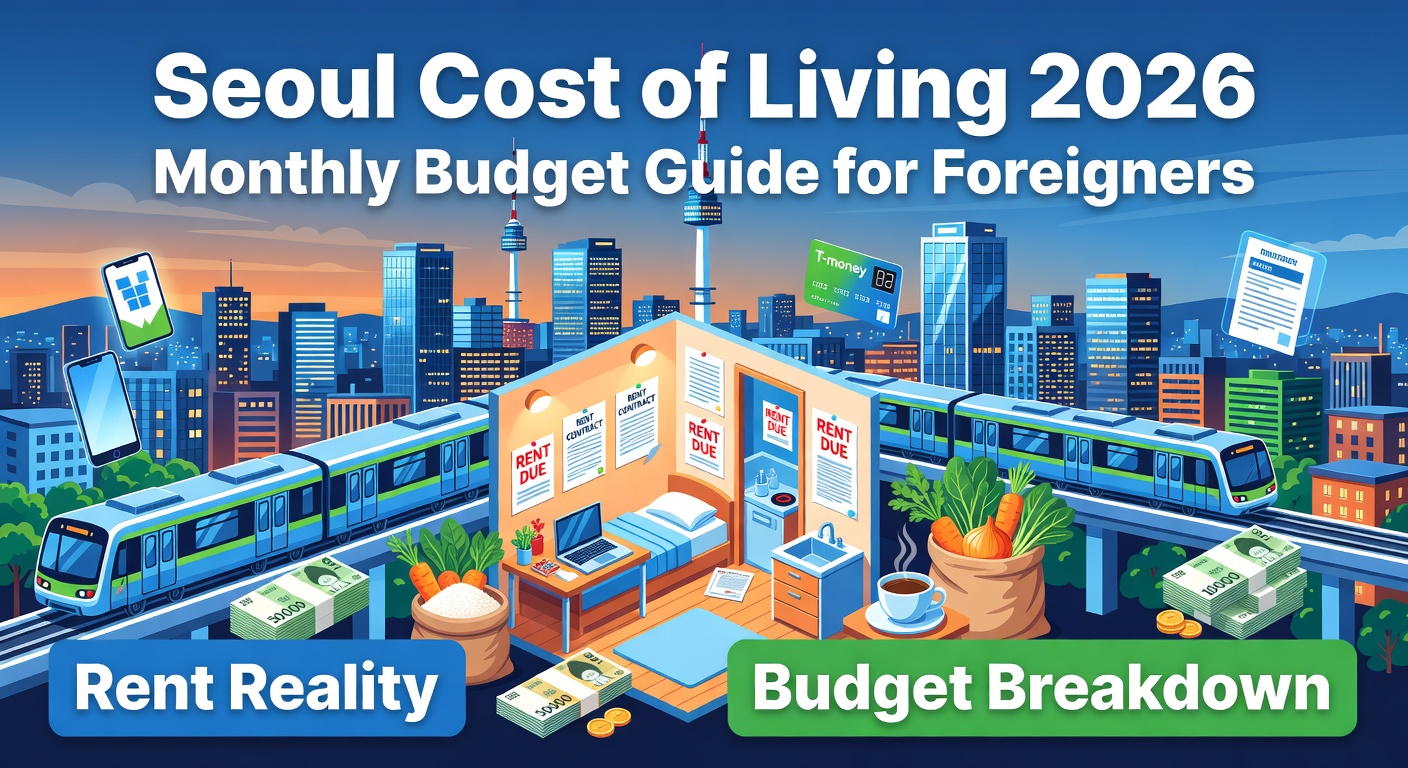
Housing eats the largest chunk of any Seoul budget, and it is also where the Korean system confuses newcomers the most. There are three main rental structures you will encounter:
Wolse (월세) is a monthly rent system with a smaller deposit, typically ₩3–10 million upfront plus monthly payments. This is what most foreigners use. For a single-person studio or officetel (a studio apartment in a mixed-use building), expect ₩700,000–1,150,000 per month in central Seoul neighborhoods.
Jeonse (전세) is Korea's unique large-deposit system where you pay a lump sum — often ₩100–300 million for a one-bedroom — and pay no monthly rent. The landlord holds your deposit and is expected to return it when your lease ends — but jeonse deposit disputes have become more common in recent years, and foreigners should look into deposit protection insurance (전세보증보험) before signing any contract. Most foreigners cannot access jeonse easily in the first place, since banks rarely approve jeonse loans for non-residents without established Korean credit.
Share houses split costs among residents, typically running ₩400,000–700,000 per person including maintenance fees and sometimes utilities. Privacy is limited, but the price and the built-in social network make it popular with students and short-term residents.
| Housing Type | Monthly Cost | Deposit | Best For |
|---|---|---|---|
| Share house | ₩400K–700K ($310–$540) | ₩0.5–2M | Students, short stays |
| Studio / One-room (wolse) | ₩700K–1,150K ($540–$885) | ₩3–10M | Working expats, long-term |
| Officetel (nicer studio) | ₩800K–1,300K ($615–$1,000) | ₩5–15M | Professionals wanting newer buildings |
| 2-room apartment (wolse) | ₩1,500K–2,500K ($1,150–$1,920) | ₩10–30M | Couples, families |
| Jeonse (전세) | ₩0/month | ₩100–300M+ | Long-term, with large savings |
One detail that catches many newcomers off guard: gwanlibi (관리비), the monthly building maintenance fee. It ranges from ₩50,000–150,000 and is often not included in the listed rent price. Always ask whether gwanlibi covers utilities or if electricity, gas, and water are billed separately. Some listings look cheaper until you add gwanlibi and separate utility bills on top.
If you are apartment hunting, the main platforms are Zigbang, Dabang, and the Naver Real Estate section. Many landlords are cautious about renting to foreigners without a Korean guarantor, so having your Alien Registration Card (ARC) and proof of employment or enrollment ready speeds things up considerably.
Food: Where Your Budget Has the Most Flexibility
Food is where lifestyle choices create the widest cost gap. Seoul is a city where you can eat a full meal for ₩5,000 at a local kimbap shop or spend ₩50,000 per person at a trendy Itaewon restaurant without blinking.
Cooking at home keeps your monthly grocery bill to roughly ₩400,000–600,000 ($310–$460). Korean supermarkets like Emart, Homeplus, and Lotte Mart offer affordable produce, rice, and Korean staples. International ingredients — imported cheese, specialty sauces, Western-brand cereals — cost significantly more and can push grocery bills up 30–40% if you rely on them heavily.
Mixing home cooking with eating out (roughly 50/50) lands most expats at ₩600,000–1,000,000 per month ($460–$770). A typical Korean lunch set at a neighborhood restaurant runs ₩8,000–12,000, and that is where most working expats end up eating on weekdays.
Eating out for almost every meal pushes food costs to ₩800,000–1,200,000+ ($615–$920+). At ₩10,000–15,000 per meal average, three meals a day adds up fast. Delivery apps like Baemin and Coupang Eats are convenient but add delivery fees of ₩2,000–4,000 per order.
One of the most consistently flagged budget surprises in expat forums and monthly expense breakdowns is coffee culture. A daily Americano at a Seoul cafe costs ₩4,500–6,000, which quietly adds ₩135,000–180,000 per month. Convenience store coffee (₩1,500–2,000) or brewing at home cuts that dramatically.
Utilities, Transport, and the "Invisible" Monthly Costs
Beyond rent and food, several recurring costs quietly shape your monthly total.
Utilities for a single-person home — electricity, gas, water, and internet — typically total ₩150,000–250,000 per month ($115–$190). Winter heating pushes this higher by ₩50,000–100,000 during December through February, since most Seoul homes use gas-powered ondol (floor heating). Summer AC adds a smaller but noticeable bump to electricity bills. Internet is fast and relatively cheap at around ₩20,000–30,000 per month for fiber connections.
Mobile phone plans run ₩30,000–55,000 for data-heavy plans through the big three carriers (SKT, KT, LG U+). Budget MVNOs offer usable plans from ₩15,000–25,000 if you are comfortable with slightly less coverage.
Public transportation is Seoul's biggest bargain. The subway and bus system is extensive, clean, and cheap. A T-Money or Climate Card (기후카드) gets you around for ₩50,000–70,000 per month with normal commuting. The Climate Card, introduced in 2024, offers unlimited Seoul metro and bus rides for ₩65,000/month — a strong deal if your commute involves multiple transfers. If you live further out or travel heavily, ₩100,000 per month is a reasonable upper estimate.
National Health Insurance (NHI) is mandatory for foreigners staying over 90 days. Monthly premiums are income-based — the National Health Insurance Service's standard rate schedule puts typical single-person premiums between ₩80,000–150,000 ($60–$115), though your exact amount depends on your declared income and employment type. This covers a significant portion of medical and dental costs at Korean hospitals and clinics. Many people find the NHI enrollment process confusing because it happens automatically for employees (your employer handles it) but requires manual sign-up for students and freelancers through the local NHI office.
A Realistic Monthly Budget: Three Scenarios
Here is what a full monthly budget actually looks like when you add everything together. These figures assume a single person living alone (not sharing), based on 2026 Seoul pricing from Numbeo, Nomads, and Asia Lifestyle Magazine's 2026 expat guide.
| Category | Budget (₩/month) | Mid-Range (₩/month) | Comfortable (₩/month) |
|---|---|---|---|
| Rent (studio) | 500K (share house) | 850K | 1,200K |
| Gwanlibi + Utilities | 100K | 180K | 250K |
| Food (groceries + eating out) | 450K | 700K | 1,000K |
| Transport | 55K | 70K | 120K |
| Phone + Internet | 40K | 55K | 65K |
| Health Insurance (NHI) | 80K | 110K | 150K |
| Social / Entertainment | 100K | 250K | 500K+ |
| Total | ~₩1,325K (~$1,020) | ~₩2,215K (~$1,700) | ~₩3,285K (~$2,530) |
The budget tier is tight but doable — many language students and part-time English teachers manage it. The mid-range tier is where most full-time working expats settle. The comfortable tier reflects professionals who eat out regularly, maintain a gym membership, and do not track every purchase.
One thing most budget breakdowns miss: the first month is always more expensive. You will need to pay a deposit (even share houses require ₩500,000–2,000,000), buy household basics, get a Korean phone plan, and potentially buy bedding or kitchen supplies. Budget an extra ₩500,000–1,500,000 for setup costs depending on how furnished your place is.
Seoul vs Other Korean Cities
If your work or studies allow flexibility on location, it is worth knowing that Seoul is the most expensive city in Korea by a meaningful margin. UpGrad's 2026 cost analysis and multiple expat sources confirm that Busan and Daegu run roughly 10–20% cheaper overall, with the biggest savings in rent — studios in Busan or Daegu often cost ₩400,000–700,000, compared to Seoul's ₩700,000–1,150,000.
The trade-off is real, though. Seoul has the densest subway network, the most international community, the best English-language services, and the widest job market for foreigners. If you are working remotely and do not need Seoul specifically, cities like Busan offer a noticeably lower cost of living with excellent quality of life. But if your Korean employer, university, or social network is Seoul-based, the convenience premium is usually worth paying.
Setting Up Your Finances as a Foreigner
Getting your financial infrastructure right in the first few weeks saves headaches later. Once you have your Alien Registration Card (ARC), open a Korean bank account — Hana, Shinhan, and KEB are the most foreigner-friendly, with some branches offering English-speaking staff.
Korean daily life runs heavily on card payments and mobile pay apps. KakaoPay and Naver Pay work at most stores and restaurants, but setting them up requires a Korean bank account and phone number. T-Money cards for transit can be bought at any convenience store and recharged at subway stations.
For tracking your spending, many expats use their Korean banking app's built-in categorization alongside a simple spreadsheet. Korean card statements automatically sort purchases into food, transport, and shopping categories, which makes monthly reviews straightforward.
If you are receiving income from abroad, be aware that international wire transfers typically cost ₩10,000–30,000 per transaction at major banks. Services like Wise typically offer better rates than major bank wire desks for regular transfers from overseas accounts to Korean won.
What Changes in 2026 — and What Stays the Same
For anyone comparing 2026 numbers against older blog posts: Seoul's cost of living has crept up gradually rather than spiked. According to multiple tracking sites, grocery prices and rent have risen by single-digit percentages annually over the past two years, with no major new regulations or tax changes affecting foreigners specifically in 2026.
The NHI system, foreigner registration process, and visa fee structures remain essentially unchanged from late 2024. If you are reading a guide from 2024 or 2025, most of the process information is still accurate — just adjust the specific won figures upward by roughly 5–10% to account for general inflation.
One practical note: always budget 10–15% above your calculated baseline. Unexpected costs — a doctor visit, a broken appliance, a friend visiting who you want to show around — appear every month. A small buffer prevents a manageable budget from becoming a stressful one.
Frequently Asked Questions
Q. How much money do I need per month to live in Seoul as a foreigner?
A single person should plan for roughly ₩1.5–2.5 million per month ($1,150–$1,920) including rent, depending on housing type and lifestyle. Budget-conscious students in share houses can manage on ₩1.3 million, while professionals in private studios with active social lives typically spend ₩2.2 million or more.
Q. Is Seoul expensive compared to other cities in South Korea?
Seoul is the most expensive city in Korea, with rent and dining costs running 10–30% higher than Busan, Daegu, or other major cities. The difference is most pronounced in housing — studios that cost ₩800,000 in Seoul might be ₩500,000 in Busan for comparable quality and size.
Q. How much is rent for a one-room apartment in Seoul 2026?
A one-room studio or officetel in Seoul costs ₩700,000–1,150,000 per month in wolse (monthly rent) format as of early 2026, plus a deposit of ₩3–10 million. Prices vary significantly by neighborhood, with Gangnam and Hongdae areas costing 20–40% more than outer districts.
Q. Do foreigners have to pay health insurance in South Korea?
Yes. Foreigners staying longer than 90 days must enroll in Korea's National Health Insurance system. Monthly premiums range from roughly ₩80,000–150,000 depending on income, and coverage includes most medical, dental, and hospital services at Korean healthcare facilities.
Q. What is the cheapest way to live in Seoul as a foreign student?
Living in a share house (₩400,000–700,000/month), cooking at home using Korean ingredients and university cafeterias (₩3,500–5,000 per meal), using the Climate Card for unlimited transit (₩65,000/month), and choosing an MVNO phone plan (₩15,000–25,000/month) can keep total monthly costs around ₩1.0–1.3 million including housing.

IT Engineer · Content Creator
Practical guides based on official sources — simple and actionable.
View all posts →