If you've lost count of how many times you've hit snooze and vowed, 'Today will be different,' then your mindset likely isn't the problem.
Your routines aren't reverting because of a lack of willpower. It's because familiar actions are stored in your brain as 'mindless execution pathways.' As The Power of Habit explains, habits become automated through a cue → action → reward loop. So, to change a routine, you don't need to muster more willpower; you need to redesign that loop itself.

Why Do Routines Always Revert?
The more tired or busy we are, the more we default to our old ways. Our brains find it comfortable.
Think about when a new routine collapses; it often starts with, 'I'm just too exhausted today.' This isn't a motivational issue; it's a design flaw. Positive actions should be easy enough to start even when you're tired, and actions you want to stop should be inconvenient enough to deter you. Willpower is finite, and daily fatigue is unpredictable. For a routine to stick, your environment must support it.
The starting point for routine transformation is structure, not resolution.
Start by Changing Your Standards, Not Your Schedule
When people decide to change their routines, most start by rewriting their schedules. Things like 'wake up at 6 AM, exercise, then study English at 7 AM.' However, this approach often fails within days because the motivation usually fades before the action does.
Lasting routines begin when the 'why' is clear, not just the 'when' and 'what.' As research on value-based goals by the Association for Psychological Science shows, when an action is linked to your core values or important objectives, motivation lasts longer, and it's less likely to crumble even when external circumstances shift.
'30 minutes of English daily' is less powerful than 'I study English to maintain a sense of growth even after work.' It's not about the size of the goal, but the depth of the reason. When your standards are clear, you'll start to see which routines are truly necessary for your life right now.
The More You Want to Change, The Smaller You Should Start
If you try to design a perfect routine from the outset, your imagination will outpace your execution. And on days you can't be perfect, you'll likely abandon it entirely.
The core of Stanford's B.J. Fogg's 'Tiny Habits' methodology is simple: start so small that you encounter no resistance. This builds successful experiences, which then allows for expansion. It's okay if it feels embarrassingly small.
- Read for 30 minutes → Open a book and read 2 pages
- Exercise for 1 hour → Do 3 squats
- Write a journal → Jot down one line before bed
Routines last much longer when built on increasing the frequency of success, rather than relying on sheer willpower. Starting small doesn't mean your goals are small. You need to get in the door before you can expand.
Re-Bundle Your Day with Cue, Action, Reward
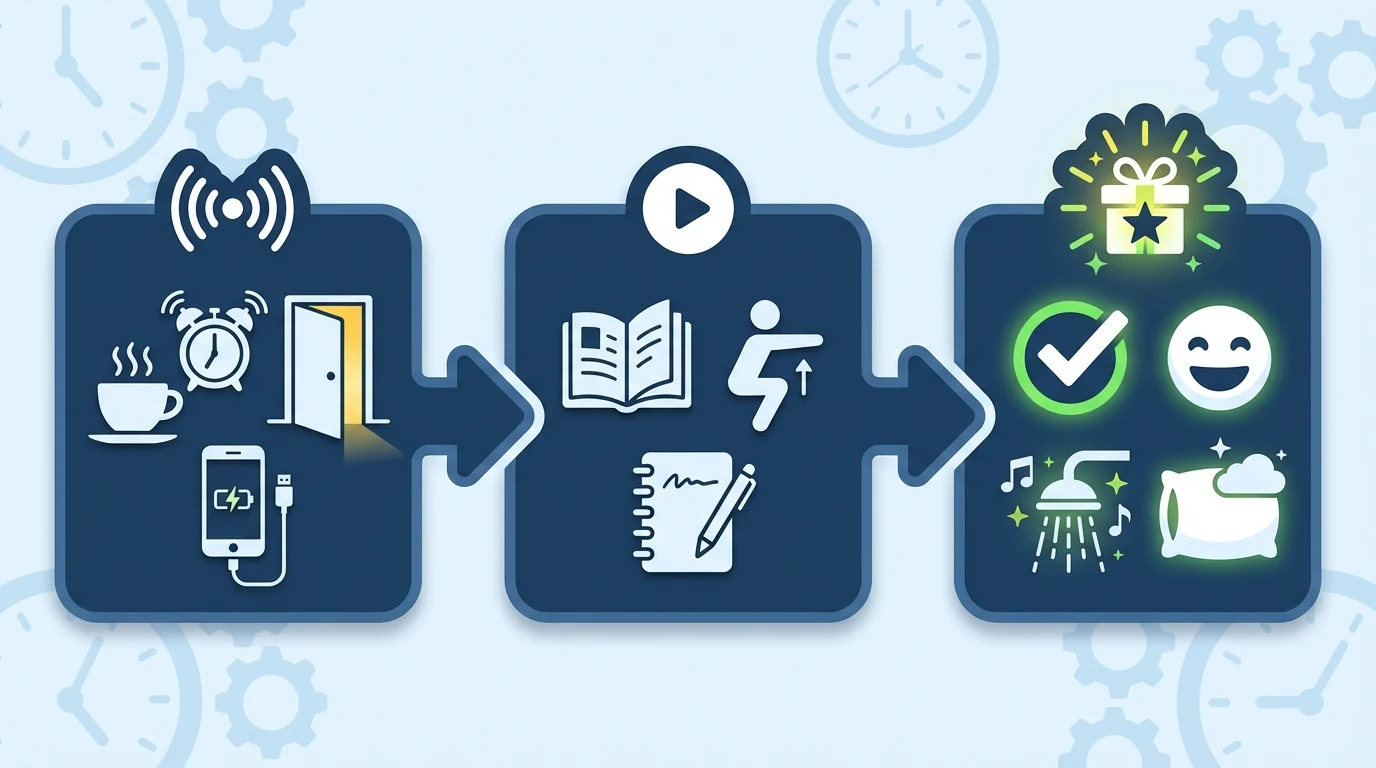
Just deciding on an action doesn't create a routine. Your brain needs to remember and repeat it, which means defining the situation that triggers the action (cue) and ensuring something good follows it (reward).
| Cue | ||
|---|---|---|
| Brew morning coffee | Read 2 pages of a book | Make a checkmark |
| Get home from work | Change into workout clothes | Listen to favorite music after showering |
| Plug in phone to charge | Write down 1 task for tomorrow | Lie down with a clear mind |
Rewards don't need to be grand. An immediate feeling of 'this action feels good' is enough. For those struggling to establish routines, it's often more effective to clarify the cues rather than increase the number of action goals.
A Well-Designed Routine Isn't Rigid; It's Adaptable
If you create a routine and believe you must stick to it forever, you'll only feel overwhelmed. As life changes, your routines should adapt accordingly.
The core of the growth mindset, as emphasized by Harvard Business Review, is similar. During periods of significant change, it's crucial to view setbacks not as proof that 'I'm incapable,' but as a sign that 'this design doesn't fit the current situation.' If you're working late more often, shift your routine to the morning, reduce it from 7 days a week to 3, or further shrink the action unit.
Caution: If a routine becomes a standard for self-reproach when you fail to follow it, it's no longer a tool for productivity but a source of pressure. Reviewing should be a signal for design modification, not self-blame.
Questions to Ask When Your Routine Falters
Before trying to boost your motivation, examine your routine's design; most problems will become apparent.
- Is this action truly connected to my current goals or values?
- Is the starting unit still too large?
- Are the cues vague, forcing me to rely solely on memory each time?
- Is my environment set up to make good habits easy and bad habits difficult?
- Am I interpreting a missed day as a sign to give up?
Answering these questions often reveals that the issue wasn't a lack of willpower, but a design flaw. When you change the design, restarting becomes much lighter.
The routine transformation strategy isn't about living a harder life. It's about building a structure you can return to, even on tired and busy days.
You don't need to change much right away. One reason, one tiny action, one clear cue. Routines begin to transform not on the day of a grand resolution, but on the day of a small design.