If it's March and your New Year's resolutions from January are still mostly blank, it might not be a lack of willpower. It's often not because you didn't have a plan, but because you lacked the structure to get back on track when things went awry.
One of the key trends highlighted by trend media for 2026 is `Ready-core`. This refers to an attitude that prioritizes proactive preparation and self-directed planning over spontaneous choices, fostering a lifestyle that remains resilient even in the face of unpredictable changes.
Note: Ready-core is not an academically established self-improvement theory, but rather a consumer and social trend keyword for 2026. It's best utilized not as a perfect system, but as a perspective to make your life less susceptible to disruption.

Why is Preparatory Self-Improvement Gaining Attention Now?
In the past, the 'just do it' approach often worked. However, with AI-driven job restructuring, accelerated career shifts, and economic uncertainties converging, that strategy is no longer as effective. Professionals, in particular, are the first to feel this shift.
As a result, what people are seeking isn't more information, but rather preparation methods that offer greater stability. The rapid growth of services that aid planning and preparation in areas like learning, financial planning, and healthcare falls within the same context. This indicates that in self-improvement, prepared repetition has become more crucial than sheer effort.
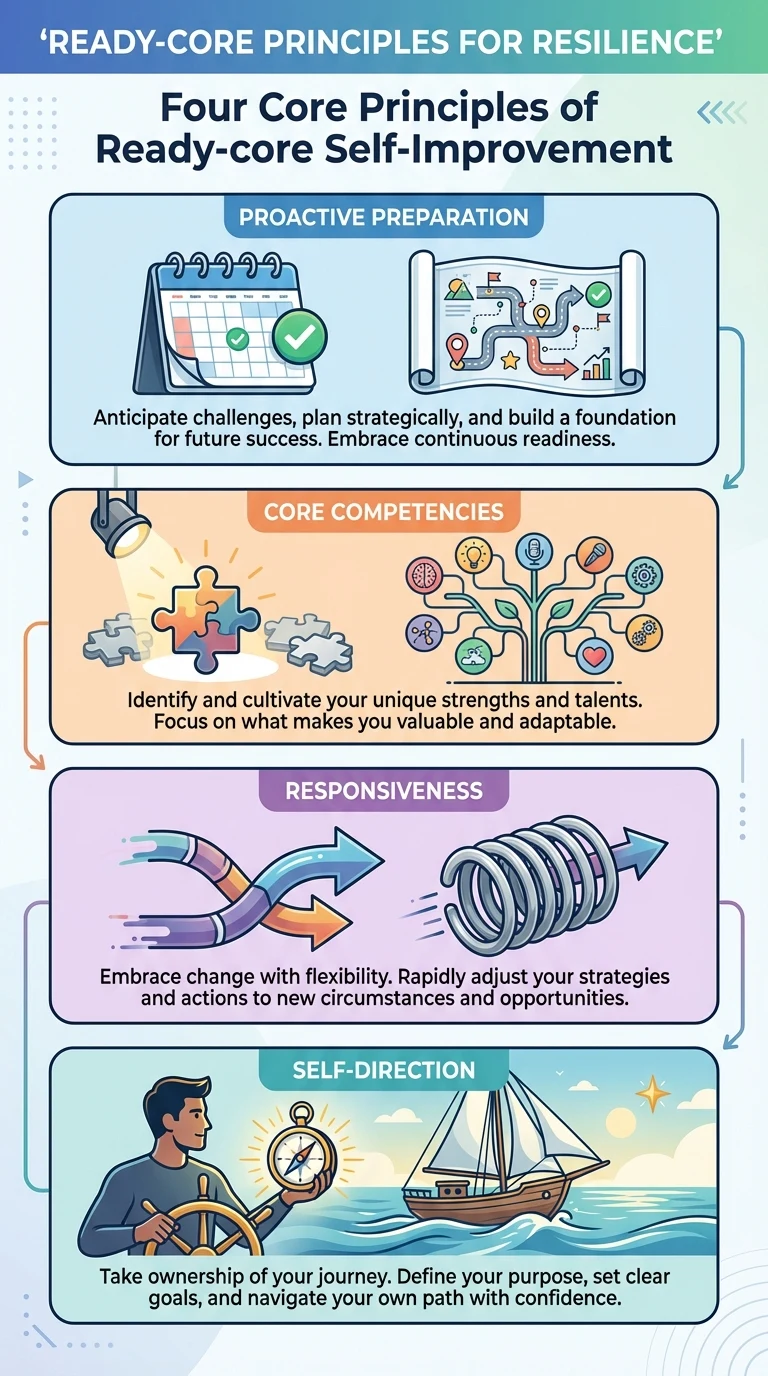
Four Core Principles of Ready-core Self-Improvement
Proactive Preparation. Do you have alternative routines that prevent you from completely abandoning your studies, even if sudden overtime or unexpected variables arise? There's a significant difference a month later between someone who has a recovery routine when plans fall apart and someone who doesn't.
Your Unique Core Competencies. Do you know what's truly essential for your current career, rather than just studying what everyone else is? Effort without direction often leads to burnout.
Responsiveness to Change. When your plans go awry, can you quickly re-prioritize instead of pausing for days? Your speed of recovery is a skill in itself.
Self-Direction. Do you have a personal standard that allows you to restart on your own even when external motivation wanes? This is where the difference lies between those who continue learning after a course ends and those who don't.
These four principles all point in the same direction: the approach of those who endure, not just those who do a lot.
How to Apply Ready-core in Practice
Narrow down your goals using the SMART method. A goal like "I want to be good at English" is hard to sustain. When deadlines and frequencies are clear, such as "Complete 15 sessions of 20-minute English shadowing on weekdays over 4 weeks," your execution rate will change. Structure lasts longer than willpower.
Create cues before relying on willpower. Habits are formed in a cycle of cue → routine → reward. By attaching automatic triggers before an action, such as "10 minutes of reading after morning coffee" or "one lecture after putting down my bag when I get home," you reduce the need for willpower.
Overcome the 3-day hurdle before the 66-day mark. There's a common guideline that it takes about 66 days for a habit to fully solidify. While individual differences exist, judging "this isn't for me after 3 days" is far too premature. Not interpreting initial wobbles as failure is itself a Ready-core mindset.
Routines, not mood, build skills. If you only work on your skills on good days, progress will be slow. By defining a minimum action you can do even on bad days—for example, listening to 5 minutes of a lecture or reviewing 5 vocabulary words—you reduce gaps. The role of a routine is not peak performance, but consistency.
When Preparation Becomes Anxiety
The biggest pitfall of Ready-core is when preparation itself becomes the goal. If your schedule becomes increasingly packed but actual action dwindles, and you're merely accumulating new apps and course lists, that's not preparation; it's anxiety management.
Effective Ready-core isn't about having many plans. It's about being in a state where you can restart even when unexpected things happen. Begin small, and keep your criteria simple.
Your Ready-core Routine: Start Today
- Set just one goal for this month.
- Write down the time and place to execute that goal in one sentence.
- Reduce the action to a size that can be completed within 10-20 minutes.
- After completion, attach a small reward, like a checkmark or a brief note.
- For two weeks, persist by adjusting rather than giving up.
Conclusion
Ready-core self-improvement isn't about living a harder life. It's a proposition to establish your life's core and preparation methods first, so you don't collapse when shaken.
A prepared person isn't a perfect person, but one who possesses mechanisms to pick up and continue.