If you've ever hesitated to put company documents into an external AI, you need to know that this concern is now escalating to a national level.
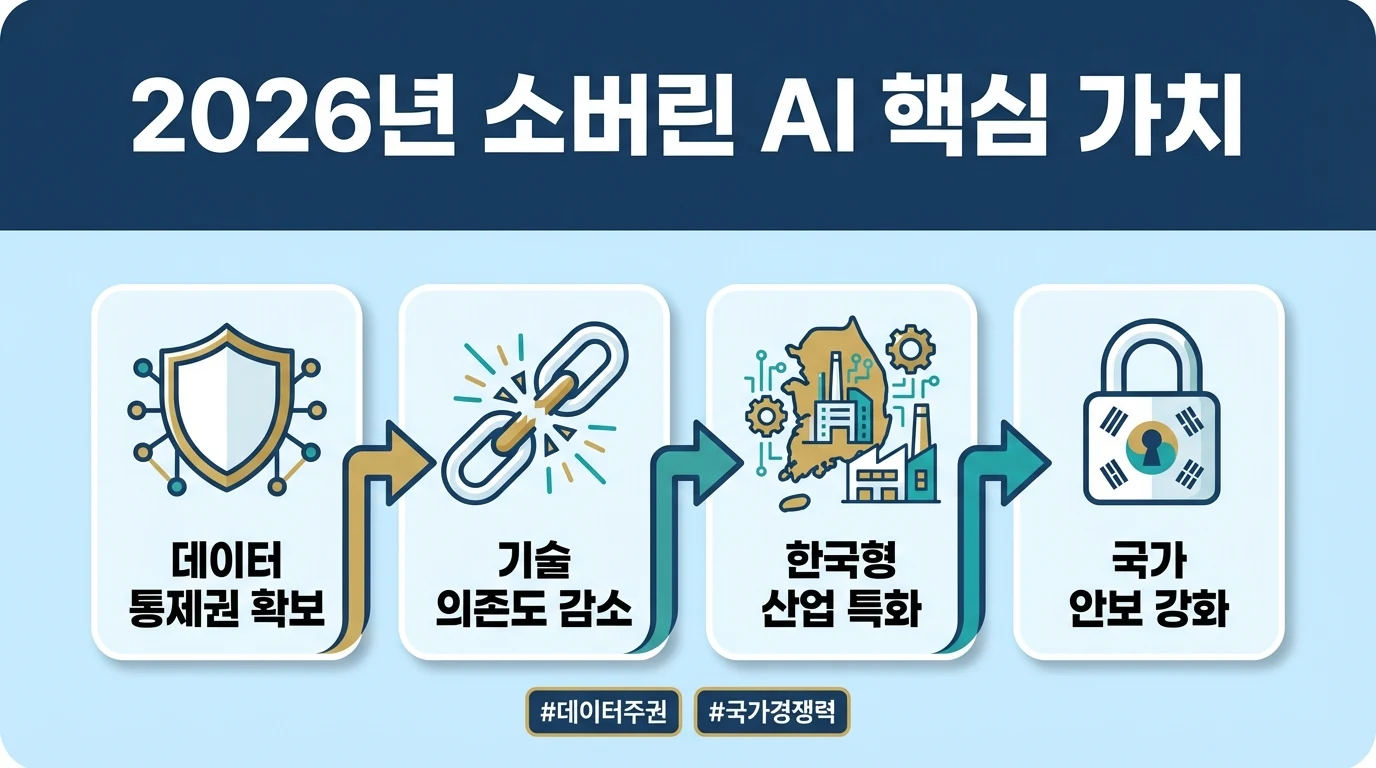
By 2026, the AI competition is no longer just about "who creates the smartest model." The core has shifted to what data is used, what infrastructure it runs on, and whose control the AI operates under. Sovereign AI refers to a strategy of independently developing and operating AI systems based on a nation's own data, technology, and infrastructure. Its purpose is to reduce reliance on foreign technology and protect data sovereignty and national interests.
Why These Two Concepts Are Always Linked
While "domestic hyper-scale AI" (often referring to Large Language Models, LLMs) and Sovereign AI may seem similar, their emphasis differs.
Hyper-scale AI refers to large-scale artificial intelligence models trained on massive data and computing resources. Like GPT-4 or Naver's HyperCLOVA X, they can handle a wide range of tasks, from language understanding to code generation. Sovereign AI, however, places more weight on control than on the model's size. The key questions are where the data is stored, who governs the training and operation, and who manages the infrastructure.
Simply put: if hyper-scale AI is the "engine," Sovereign AI is about "whose garage that engine is in, and who holds the keys."
This is why discussions about domestic AI models in Korea naturally lead to a Sovereign AI strategy. In sensitive areas like finance, healthcare, public services, and national defense, increasing reliance on foreign models can escalate risks of data leakage, technological dependency, and national security vulnerabilities.
Korean Companies Building AI: Beyond Performance, 'Context' is Key
The significance of domestic models goes beyond simply "being made by a Korean company." True competitiveness comes from integrating Korean language understanding, local industry context, sensitive data processing environments, and seamless connectivity with corporate systems.
Naver's HyperCLOVA X, developed with vast Korean language data, is directly applied to its search, commerce, and cloud services. While Korean language optimization might seem like a mere convenience feature, it is a critical factor determining work accuracy and service quality.
KT has developed its hyper-scale AI, 'Mi:dm,' using its own data, including telecommunication data, and provides it as AI-as-a-Service (AIaaS) to B2B markets across various industries like finance, healthcare, and education. The notable aspect here is the direction: the focus is shifting from "general-purpose chatbots" to "AI directly integrated into industrial sites."
LG's EXAONE follows a similar trend. It is expanding its use in core industries such as manufacturing, chemicals, and biotech for research and problem-solving, gaining prominence not for consumer buzz but for genuinely solving industrial challenges.
When you factor in the data center investments and security enhancements by domestic cloud companies, it becomes clear that Sovereign AI is not just about a single model but an issue concerning the entire ecosystem.
The World is Already Solidifying 'Sovereignty' into Law
Europe started with rules. The EU's AI Act legally defines the safety, transparency, and trustworthiness of AI systems, explicitly protecting citizen data and ensuring regional AI technological independence. This approach prioritizes building a "reliable system" over merely a "good model."
The United States has taken a different path. It aims to maintain global AI leadership by focusing on private-sector-led innovation while investing heavily in national security and talent development. This structure balances market speed with national strategy.
China's state-led approach is even stronger. It concentrates vast resources and data within a domestic enterprise-centric ecosystem, strengthens data control, and positions AI as a core pillar of its national strategy.
Despite different approaches, there's one common thread: major nations all treat AI not merely as an industrial technology but as an issue of sovereignty, security, and economy. This is why Korea, too, must design a "sustainable domestic AI system" rather than just "one effective model."
When This Trend Becomes Truly Significant
For businesses, the questions around AI adoption are changing. They are shifting from "Which AI performs best?" to "Does it fit our data environment, can it handle domestic regulations, and are there long-term risks of technological dependency?"
For policymakers, fostering domestic AI is not just an issue of industrial support. Sovereign AI can only truly function when data, cloud infrastructure, security, regulations, and talent are all interconnected. Nurturing models without designing an ecosystem is a half-baked strategy.
For general users, this trend is also becoming increasingly relevant. As AI deeply integrates into search, work tools, education, medical consultations, and financial services, the country's standards and infrastructure upon which an AI operates will directly impact service reliability and quality.
A Realistic View, Without Exaggeration
The emphasis on domestic hyper-scale AI and Sovereign AI does not mean that foreign models will be immediately replaced in all areas.
Note: Some corporate examples and policy information cited in this article are based on the 2023-2024 timeframe. Given the rapid pace of change in the AI field, it is advisable to verify the specific current status for 2026 directly.
Balance is also crucial. If Sovereign AI leads to isolation or inefficiency, it will lose competitiveness. Conversely, relying solely on external technology might offer convenience but risks losing control. The key lies in finding the right balance between self-reliance and cooperation, and Korea's AI strategy in 2026 will be evaluated at precisely that juncture.
Conclusion
Domestic hyper-scale AI and Sovereign AI are not just buzzwords. They represent practical questions: Where does my data go? Whose technology does our industry rely on? What kind of negotiating power will Korea have in the age of AI?
In the 2026 competition, there is one crucial criterion. It's not about whether performance looks good, but whether it aligns with our language and industries, and whether it can be operated under our control for the long term. The side that can properly answer this question will lead the way.