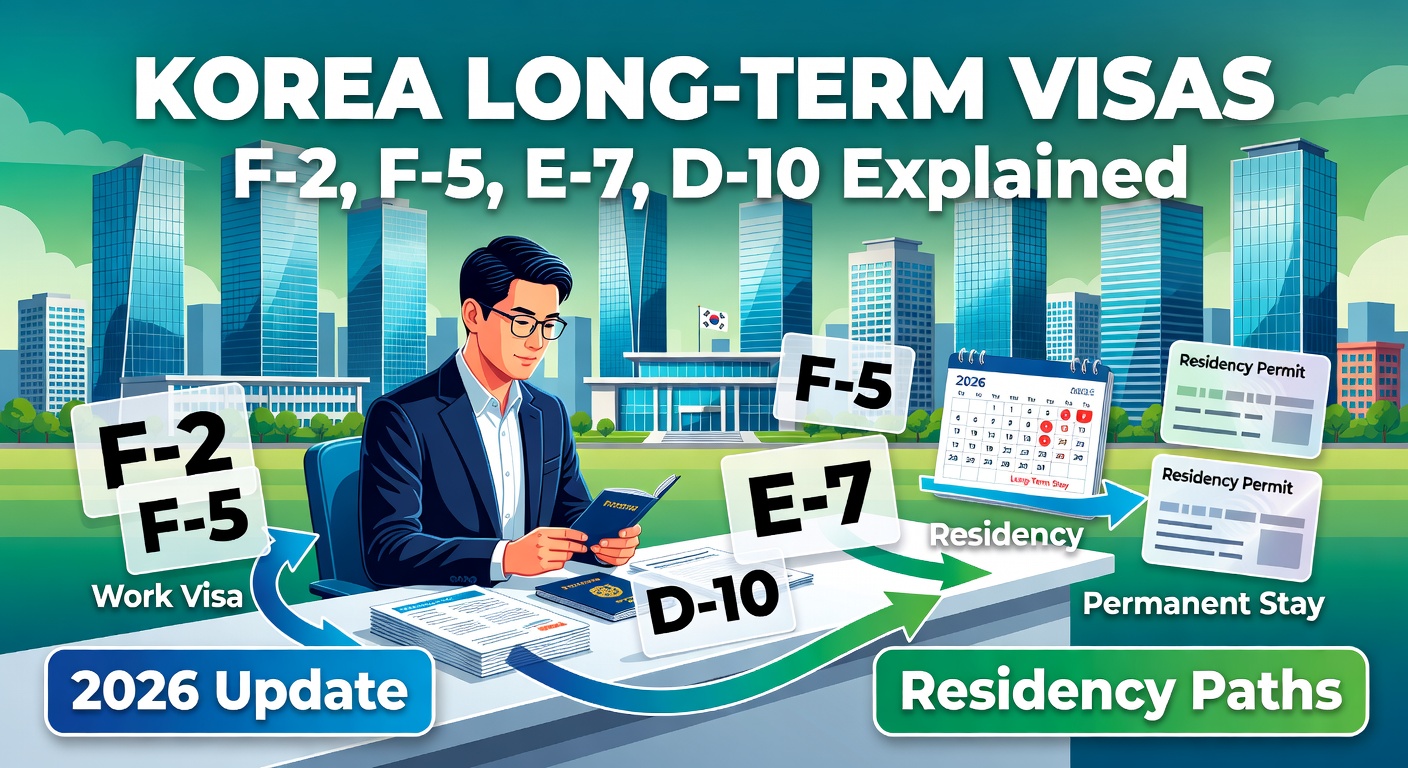
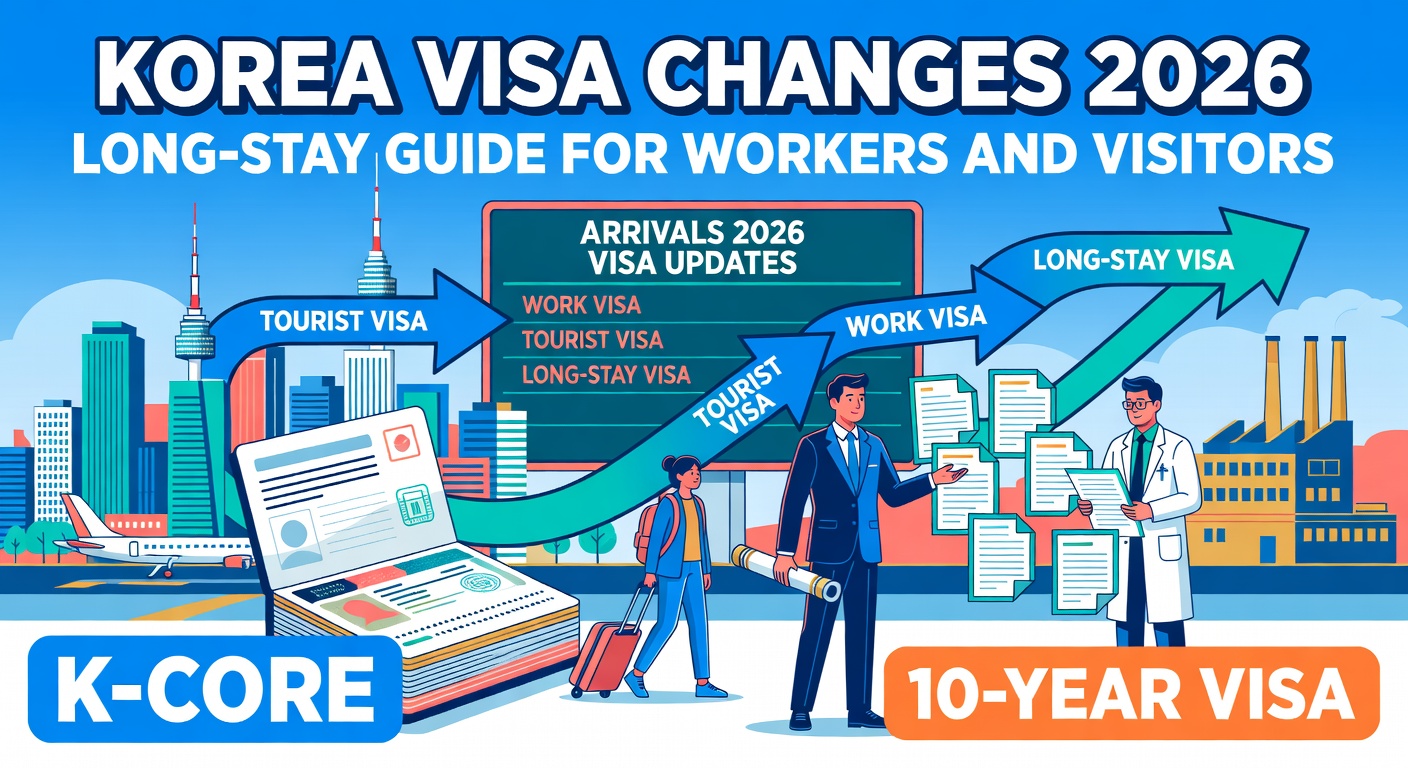
Korea Visa for Foreigners — Your 2026 Residency Guide
You have a job offer in Seoul, a university acceptance letter, or maybe a Korean spouse — and now you're staring at a list of visa codes that looks like an alphabet soup. C-3, D-8, E-7, F-2, F-5… each one with different rules, different documents, and different consequences if you get it wrong. The 90-day clock starts ticking the moment you land, and missing the registration deadline means fines or, worse, deportation.
This guide breaks down the visa categories that matter most for long-term residents in 2026, walks through the application and extension process step by step, and flags the policy changes announced in March 2026 under Korea's new "2030 Immigration Strategy." By the end, you'll know exactly which visa fits your situation, what documents to prepare, and how to avoid the mistakes that trip up thousands of foreigners every year.
How Korea's Visa System Is Organized
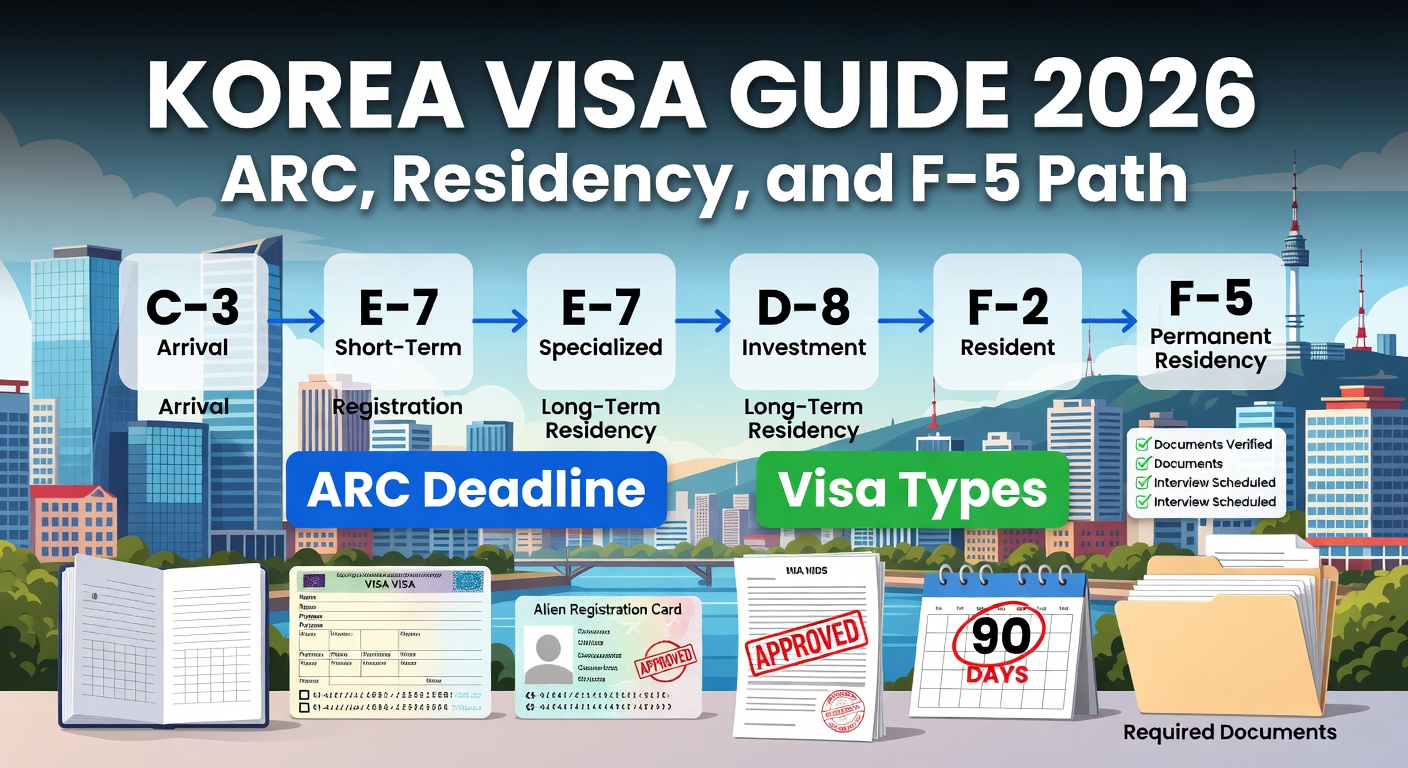
Korea's immigration system splits foreign residents into dozens of status categories, each identified by a letter-number code. For most people planning to stay longer than 90 days, the categories that matter fall into a few broad groups.
Short-term visas like C-3 (tourism/business) cover stays of 90 days or less. These are straightforward but almost impossible to extend into long-term status from inside Korea. If you entered on a tourist visa hoping to "figure it out later," you'll likely need to leave the country and re-enter on the correct visa.
Work visas include E-7 (professional employment), E-2 (English teaching), and the various E-series categories for specific industries. These tie your legal status directly to your employer, which means changing jobs requires immigration office approval.
Investment and business visas like D-8 require proof of a minimum capital investment. The threshold and documentation differ depending on your business type.
Residency visas — F-2 (resident) and F-5 (permanent resident) — offer the most freedom. F-2 holders can work without employer-specific restrictions, and F-5 is effectively a permanent stay permit with almost no limitations on employment.
Overseas Korean visas (F-4) follow a separate track with their own registration process called geososingo (거소신고), not the standard Alien Registration Card.
Many people find the distinction between D-series and E-series visas confusing because both involve working in Korea. The key difference: D visas are generally for self-directed activities (study, business, training), while E visas are employer-sponsored work permits. Getting this wrong at the application stage can delay your entire process.
| Visa Code | Category | Duration | Best For |
|---|---|---|---|
| C-3 | Short-term visit | Up to 90 days | Tourism, short business trips |
| E-7 | Professional employment | 1–3 years (renewable) | Skilled workers, IT professionals, engineers |
| D-8 | Corporate investment | 1–2 years (renewable) | Business owners, startup founders |
| F-2 | Long-term resident | 1–5 years (renewable) | Points-based residency, spouse visa holders |
| F-5 | Permanent resident | Indefinite | Long-term residents meeting income/language requirements |
| F-4 | Overseas Korean | 2 years (renewable) | Ethnic Koreans with foreign citizenship |
🔗 Korea Visa Portal — Full Visa Category List
Korea had over 2.78 million registered foreign residents by the end of 2025, according to the Ministry of Justice — a 5% jump from the previous year. The system is large, active, and constantly being updated. That brings us to what changed in 2026.
What Changed in March 2026: The "2030 Immigration Strategy"
On March 2, 2026, the Ministry of Justice announced its 2030 Immigration Policy Future Strategy, the most significant overhaul of Korea's immigration framework in years. Three changes stand out for foreign residents.
A new skilled worker visa for agriculture and fisheries (E-7-4). Previously, workers in these sectors were funneled through seasonal or non-professional categories with limited paths to long-term residency. The E-7-4 creates a recognized professional track for experienced agricultural and fisheries workers.
Expanded "Top-Tier" visa benefits. Korea is widening the fast-track pathway for high-income professionals, researchers, and individuals with advanced degrees. Specific eligibility criteria are still being finalized, but the direction is clear: Korea wants to compete harder for global talent.
Minimum wage requirements for foreign worker sponsorship. Employers sponsoring foreign workers will need to meet a "fair wage" threshold — a policy designed to prevent exploitation and ensure visa holders aren't undercutting domestic labor markets. The exact figures haven't been fully published yet, so if you're in the middle of a job negotiation, confirm the current requirements with your local immigration office.
🔗 Ministry of Justice — 2030 Immigration Strategy Announcement
The question that keeps coming up in expat communities is whether these March 2026 changes affect existing visa holders. The short answer: if you're already on a valid visa, your current status isn't retroactively changed. But your next renewal or change-of-status application will be processed under the updated rules. Keep this in mind if your visa expires in the second half of 2026.
The Alien Registration Card: Your First 90-Day Deadline
If you're staying in Korea for more than 90 days on any long-term visa, you must register for an Alien Registration Card (ARC, 외국인등록증). This is non-negotiable. Without it, you cannot open a bank account, sign a phone contract, enroll in national health insurance, or do most of the everyday things that require identity verification in Korea.
The registration process runs through Hi Korea (www.hikorea.go.kr), the Ministry of Justice's online immigration portal. Here's how it works in practice.
🔗 Hi Korea — Immigration E-Services Portal
The piece that trips most people up isn't the application itself — it's the address proof. If you're staying in a goshiwon (고시원, a small single-occupancy room) or a short-term Airbnb while apartment hunting, getting a proper address confirmation letter can be difficult. Some landlords won't provide one for short-term stays. If you're in this situation, ask your immigration office about alternative documentation before your 90-day deadline passes.
Once you have your ARC, keep it current. Any change of address must be reported within 14 days, either through Hi Korea or at your local community center (주민센터). This is another point where people commonly get caught — moving apartments and forgetting to update the registration.
Extending Your Visa and Changing Status
Visa extensions in Korea need to be filed before your current stay period expires. If you overstay even by a single day, you're technically in violation and it goes on your record, which can complicate future applications.
The extension process mirrors the initial registration: log in to Hi Korea, book an appointment, bring your updated documents, and pay the processing fee. For most work visas, you'll need a letter from your employer confirming continued employment. For F-2 residency renewals, you may need to show proof of income, tax payments, and social integration program participation.
Changing your visa status — say, from a student visa (D-2) to a work visa (E-7) — is possible without leaving Korea, but it's a separate application with its own requirements. The key is timing: apply for the change of status before your current visa expires, and make sure your new employer or sponsor has the paperwork ready.
Ask anyone who has recently renewed a visa, and the same frustration comes up: processing time variability. The Seoul Immigration Office might process your extension in a week, while offices in smaller cities could take three weeks or more. There's no official service-level guarantee, so file your extension at least a month before expiration if possible.
For those applying through a proxy (employer's HR department, immigration broker), make sure the invitation letter and supporting documents match your passport details exactly. Name mismatches — even minor romanization differences — are one of the most frequent causes of application rejection. Korea's immigration system is strict about exact name matching across all documents.
The Path to Permanent Residency (F-5)
The F-5 permanent resident visa is the endgame for many long-term expats. It removes nearly all work restrictions and allows indefinite stay in Korea. But qualifying for it requires meeting several conditions simultaneously.
Income and assets. You need to demonstrate financial stability, typically through Korean tax records showing income above a certain threshold. The exact figure varies depending on the specific F-5 sub-category you're applying under, and sources differ on the precise amounts — check the latest requirements on Hi Korea or directly with your immigration office.
Korean language ability. You'll need to prove at least TOPIK Level 2 (equivalent to A2 on the European framework) or completion of the Korea Immigration and Integration Program (KIIP, 사회통합프로그램). The KIIP route is popular because it also satisfies the social integration requirement and is free.
Clean record. No criminal violations, no history of overstaying, no outstanding tax debts.
Continuous residency. The required period varies by visa type. Some F-2 holders can transition to F-5 after a set number of years; marriage visa (F-6) holders have different timelines.
One area where many applicants find conflicting information is the exact income threshold for F-5 qualification. Different immigration offices and online sources quote different numbers, and the requirements can change with policy updates. Rather than relying on any single internet source, request the current checklist directly from your immigration office or through Hi Korea's consultation service.
🔗 Korean Government Services for Foreigners
Under the 2030 Immigration Strategy, the government has signaled interest in making F-5 more accessible for high-skilled professionals while potentially tightening requirements in other categories. Whether specific income thresholds or language requirements will shift in 2026 hasn't been officially confirmed yet — another reason to verify current rules before applying.
What Happens After Registration: Insurance, Banking, and Daily Life
Getting your ARC isn't just a legal formality — it unlocks the infrastructure you need to actually live in Korea.
National Health Insurance (NHI). Foreign residents on visas of six months or longer are automatically enrolled in the National Health Insurance system. Your employer handles the enrollment if you're on a work visa; otherwise, you register through your local NHI branch. Monthly premiums for self-enrolled foreigners are based on factors including income and property, and as of recent years, the minimum monthly premium has been steadily adjusted upward. Many newcomers are surprised by the first bill.
Banking. With your ARC, you can open a Korean bank account — essential for receiving salary, paying rent, and using mobile payment services like KakaoPay and Naver Pay. Most major banks (KEB Hana, Shinhan, Woori) have English-speaking staff at their international branches in Seoul.
Phone contracts. A Korean phone number tied to a proper contract (not a prepaid SIM) requires an ARC. This matters because Korea's identity verification system (본인인증) relies heavily on a phone number linked to your real name. Without it, signing up for online services, delivery apps, or even booking certain government appointments becomes frustratingly difficult.
The KIIP social integration program, mentioned earlier for F-5 eligibility, also serves as a practical resource. It offers free Korean language classes and cultural orientation courses. The 2030 Immigration Strategy specifically calls for expanding Korean language education access for foreign residents, so expect more class availability and potentially more emphasis on language competency in future visa assessments.
Common Mistakes and How to Avoid Them
Certain mistakes come up again and again across immigration forums and expat communities.
Filing extensions too late. Even if your paperwork is perfect, submitting an extension request one week before expiration with a three-week processing time creates a gap. File early.
Assuming tourist visa conversion is easy. Entering Korea on a C-3 short-term visit visa and trying to switch to a work visa while inside the country almost never works. Plan your visa type before arriving.
Ignoring tax obligations. Immigration officers now routinely check for tax compliance during extensions. If you have unfiled income taxes or outstanding payments, your extension can be denied regardless of your employer's sponsorship.
Name discrepancies across documents. Your passport, ARC, employment contract, and lease agreement all need to show the same name in the same romanization. Even a small inconsistency — "Mohammad" vs. "Mohammed," for example — can cause processing delays.
Not reporting address changes. Moving apartments without updating your registration within 14 days is technically a violation, and it can surface during your next extension review.
Relying on proxy applicants without verification. If your employer's HR team or a visa broker is handling your paperwork, double-check every document yourself. Forged invitation letters or incorrectly filled forms lead to permanent black marks on your immigration record.
Your Next Steps
Korea's immigration system is detailed, but it follows a logical structure once you understand which visa category you belong in and what the deadlines are. The March 2026 policy changes are still rolling out, which means some rules are in flux — this is a year to be especially careful about verifying requirements before you apply.
Start with three concrete actions: create your Hi Korea account now (even if you haven't arrived yet), confirm your visa category matches your actual purpose in Korea, and gather your documents well before any deadline. For permanent residency hopefuls, look into the KIIP program early — it takes time to complete, and it satisfies multiple F-5 requirements at once.
Immigration policy in Korea is moving toward attracting more skilled professionals while tightening enforcement on compliance. Whether you're here for a year or planning to stay permanently, staying on top of your paperwork is the single most important thing you can do.
Frequently Asked Questions
Q. How long can I stay in Korea without a visa?
Citizens of many countries can enter Korea visa-free for up to 90 days under tourist or short-term business status. The exact duration depends on your nationality and any bilateral agreements between Korea and your home country. Check the Korea Visa Portal for your country's specific terms before booking travel.
Q. Can I work in Korea on a tourist visa?
No. Working on a C-3 tourist or short-term visit visa is illegal and can result in fines, deportation, and a ban on re-entry. You must hold a valid work-authorized visa (E-series, F-2, F-5, or H-1 working holiday) before starting any paid employment.
Q. How much does it cost to apply for an Alien Registration Card?
The standard ARC application fee is ₩30,000, paid at the immigration office during your appointment. Additional costs may apply if you need document translations, notarized copies, or passport photos — the total will vary depending on what you already have prepared.
Q. What happens if I overstay my visa in Korea?
Overstaying even by one day creates a record in the immigration system. Penalties include fines, possible detention, forced departure, and multi-year entry bans depending on the length and circumstances of the overstay. If you realize you're close to your expiration date, contact your immigration office immediately about emergency extension options.
Q. Do I need to speak Korean to get permanent residency (F-5)?
You need to demonstrate at least a basic level of Korean proficiency, typically TOPIK Level 2 (A2 equivalent) or completion of the KIIP social integration program. The KIIP route is often preferred because it covers both the language and cultural knowledge requirements, and the courses are free of charge.
Recommended Posts
- Cheap Housing in Seoul Near Subway — Expat Options Compared
- Jeonse vs Monthly Rent in Korea — Compared for Foreigners (2026)
- Seoul Cost of Living 2026 — Monthly Budget Guide for Foreigners
- First Month in Korea as a Foreigner — Your Complete Setup Checklist
- Korea Visa for Foreigners 2026 — Your Complete Long-Stay Guide

IT Engineer · Content Creator
Practical guides based on official sources — simple and actionable.
View all posts →