Korea Visa for Foreigners 2026 — Your Complete Long-Stay Guide
You have a job offer from a Korean company, or maybe you have been visiting Seoul twice a year and want an easier way to come and go. Either way, the visa rules you looked up last year may already be outdated. Korea's Ministry of Justice announced a sweeping immigration overhaul in March 2026 that introduced new visa categories, relaxed tourist entry requirements, and expanded pathways for skilled workers to stay long-term.
This article breaks down every major 2026 visa change that affects foreign residents, workers, and frequent visitors — from the brand-new K-CORE visa for mid-skilled graduates to the expanded 5- and 10-year multiple-entry tourist visas, plus the extended K-ETA exemption. By the end, you will know which visa category fits your situation and what to prepare before you apply.
What Changed in 2026: The Big Picture
Korea's immigration system is shifting away from its old model of filling low-wage factory positions with temporary workers. The Ministry of Justice's 2026 Immigration Future Strategy, announced on March 3, 2026, outlined a roadmap through 2030 that prioritizes mid- and high-skilled talent, regional revitalization, and a more digitized application process.
🔗 South Korea 2026 Immigration Strategy Overview
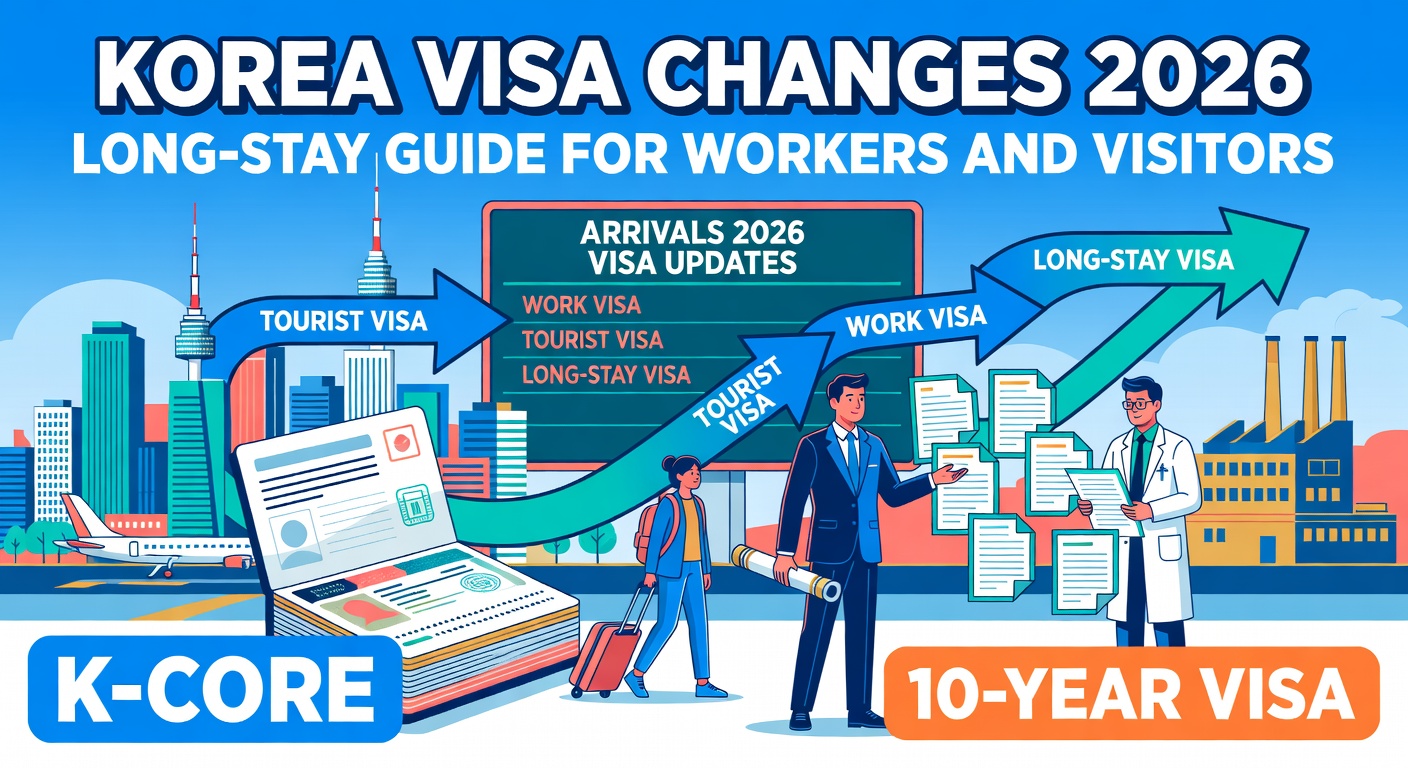
Three changes matter most. First, the Top-Tier Visa for elite professionals now covers STEM professors and researchers, not just workers in the original eight advanced industries. Second, a new K-CORE visa (E-7-M) lets foreign graduates of Korean colleges work in manufacturing and regional industries. Third, the government dramatically loosened tourist visa rules for visitors from China and Southeast Asia as part of a push to hit 30 million annual visitors.
Many people find this confusing because the changes were announced across multiple government briefings over several weeks. The tourist visa easing came from the Ministry of Culture and Tourism on February 25, the immigration strategy came from the Ministry of Justice on March 3, and the K-ETA extension was actually announced back in late 2025. They are all separate policies that happen to take effect around the same time.
The next question most foreigners ask is which of these changes actually applies to them — so let us walk through each category.
The K-CORE Visa (E-7-M): A New Path for Mid-Skilled Workers
If you graduated from a Korean junior college or university in an engineering or technical field, the K-CORE visa is the biggest development of 2026. This visa was created specifically to address labor shortages in depopulating regions — smaller cities and rural areas where factories struggle to find workers.
Here is how it works. You must have completed (or be about to complete) a degree in a science, engineering, or technical field at a Korean institution. You then sign an employment contract with a small or mid-sized manufacturer in a designated depopulation area. The application goes through a Regional Immigration Package Program, a joint initiative between the Ministry of Justice, local governments, and the Ministry of Employment and Labor.
🔗 Ministry of Justice — 2026 Immigration Policy Briefing
The K-CORE program is running as a two-year pilot from January 2026 through December 2027. Visa holders can renew in one- to three-year increments, and the program may become permanent depending on results. One thing that commonly trips people up: the specific wage floors and detailed screening criteria have not been published yet. The Ministry of Justice plans to establish a Foreign Worker Wage Advisory Committee to set these thresholds, but as of March 2026, the exact numbers are still pending.
If you are a current international student at a Korean university studying engineering, this is worth watching closely. Check with your university's international office and the local immigration office for the latest on which companies and regions are participating.
Top-Tier Visa Expansion: Attracting Global Experts
Korea's Top-Tier Visa was already one of the most generous pathways for highly skilled professionals, offering fast-tracked permanent residency. In 2026, the government expanded it beyond the original eight advanced industry sectors to include STEM professors, senior researchers, holders of Korean patents, and authors published in top-tier academic journals (SCI or Q1-ranked).
The eligibility bar remains high. You generally need a PhD from a globally ranked university (top 200), significant patents or publications, or a senior research position. But if you qualify, the benefits are substantial: long-term residency with a clear path to permanent status, and the ability to work at research institutions and advanced-industry companies.
In practice, the Top-Tier expansion primarily benefits applicants who would otherwise apply under the E-7 professional visa category. If you are a researcher or professor currently on a different visa type, it may be worth consulting with immigration to see if switching to the Top-Tier track makes your long-term stay more secure.
Tourist and Short-Stay Visa Overhaul
For visitors rather than workers, the 2026 changes are equally significant. Korea is aggressively courting international tourists, and the visa relaxation is one of the main tools.
Multiple-Entry Visas: 5-Year and 10-Year Options
Nationals from China and Southeast Asia — 11 countries in total — who have visited Korea at least once can now apply for a 5-year multiple-entry visa. Residents of major cities — Beijing, Shanghai, Hanoi, and others — may qualify for a 10-year multiple-entry visa.
🔗 South Korea Eases Visas — Chosun Ilbo
One misconception that regularly trips people up: a 10-year multiple-entry visa is not the same as residency. It means you can enter and leave Korea multiple times over 10 years, but each individual stay is still limited (typically 90 days). You cannot work on a tourist visa, and you do not receive healthcare or social welfare benefits. People sometimes confuse the long validity period with permission to live in Korea indefinitely — that is not what this visa offers.
The exact city-by-city list for who qualifies for the 10-year version has not been fully published, so check with your nearest Korean embassy or consulate for the specifics that apply to your nationality and city of residence.
Group Tourist Visa Fee Waiver
Groups of three or more tourists from China, India, Vietnam, the Philippines, Indonesia, and Cambodia are exempt from visa application fees through June 2026. This was extended from a previous measure and is part of the government's broader tourism push.
🔗 Korea JoongAng Daily — Visa Fee Waiver Extension
Keep in mind that this applies only to group travelers (three or more people entering together), not individual tourists. If you are traveling solo, standard visa fees still apply.
K-ETA Exemption Extended Through December 2026
The K-ETA (Korea Electronic Travel Authorization) exemption, originally set to end in 2024, has been extended to December 31, 2026 for nationals of certain visa-exempt countries. If your country is on the exemption list, you can skip the K-ETA application entirely during this period.
However — and this is where many travelers get tripped up — not all visa-exempt countries are included in the K-ETA exemption. If your country has a visa-exemption agreement with Korea but is not on the K-ETA exemption list, you still need to apply for K-ETA before boarding your flight. The Visit Korea website and the Fragomen immigration advisory have published updated country lists.
🔗 Visit Korea — K-ETA Exemption Details
Comparing Your Visa Options at a Glance
| Feature | Short-Stay Tourist | 5/10-Year Multiple Entry | K-CORE (E-7-M) | Top-Tier Visa |
|---|---|---|---|---|
| Purpose | Tourism, short visit | Frequent re-entry over 5–10 years | Work in regional manufacturing after graduating in Korea | Long-term work in advanced industries, research |
| Stay per entry | Up to 90 days | Up to 90 days per visit | 1–3 years, renewable | Long-term, permanent residency track |
| Can you work? | No | No (must change status) | Yes, at designated employers | Yes, in qualifying sectors |
| Best for | First-time visitors, short trips | Business travelers, family visits | Korean college graduates in tech/engineering | PhDs, senior researchers, patent holders |
| 2026 status | Fee waivers for group tourists (until June 2026) | Expanded to 11 countries | New — pilot through Dec 2027 | Expanded to STEM professors/researchers |
How to Apply: The General Process
Korea's visa application process follows a fairly standard structure regardless of visa type, though the specific documents differ. The Ministry of Justice has been digitizing the system, and 2026 introduced AI-based pre-screening for faster initial processing.
One point that catches many first-time applicants off guard: the documents you need depend heavily on your nationality, the consulate handling your case, and your specific visa category. Two people applying for the same visa type from different countries may face completely different document requirements. Always confirm the latest requirements directly with the Korean embassy or consulate in your country before submitting.
What to Watch for the Rest of 2026
Several parts of the new immigration framework are still being finalized. The Foreign Worker Wage Advisory Committee has been announced but has not yet published wage thresholds for the K-CORE visa. The exact list of cities whose residents qualify for the 10-year multiple-entry tourist visa is still being confirmed at the consulate level. And the group tourist visa-free entry expansion to Indonesia is in progress but may not match the initial timeline.
If you are building plans around any of these pending changes, treat government press releases as a direction of travel rather than settled policy. The safest approach is to confirm specifics with the Korean embassy in your country or check Hi-Korea for official updates before you book flights or sign contracts.
Conclusion
Korea's 2026 visa overhaul is the most significant immigration policy shift in years. For skilled workers and Korean university graduates, the new K-CORE and expanded Top-Tier visas create pathways that did not exist before. For tourists and frequent visitors from China and Southeast Asia, the 5- and 10-year multiple-entry visas and extended K-ETA exemption remove real friction from travel planning.
The single most important thing you can do right now is identify which visa category matches your situation, then verify the current requirements with the Korean embassy that serves your region. Policy details are still settling into place, and the difference between a government announcement and an implemented rule can be a few months. Start your preparation early, keep your documents current, and confirm before you commit.
Frequently Asked Questions
Q. Do I still need K-ETA to visit Korea in 2026?
It depends on your nationality. According to the Visit Korea official site, citizens of 22 countries covered by the Visit Korea Year exemption do not need K-ETA through December 31, 2026. If your country is not on the exemption list but has a visa-waiver agreement with Korea, you still need to apply for K-ETA before traveling. Check the Visit Korea official website for the current country list.
Q. What is the K-CORE visa and who can apply?
The K-CORE visa (officially E-7-M) is a new work visa for foreigners who graduated from Korean junior colleges or universities in technical and engineering fields. It allows you to work at small and mid-sized manufacturers in designated depopulation areas. The program is running as a two-year pilot from 2026 through 2027.
Q. Can I work in Korea on a 10-year multiple-entry tourist visa?
No. A multiple-entry tourist visa only allows you to enter and exit Korea multiple times over its validity period, with each stay limited to around 90 days. It does not grant work permission. To work legally, you need a separate employment visa, and working on a tourist visa can lead to deportation and a future entry ban.
Q. How long does the Korea visa application process take?
Standard processing times run between 7 and 14 business days for most visa categories, according to official guidance. However, this can vary depending on your nationality, the specific consulate, and whether additional documents or an interview are required. Apply well in advance of your planned travel date.
Q. Which countries qualify for the Korea group tourist visa fee waiver in 2026?
The visa fee waiver for groups of three or more tourists applies to nationals of China, India, Vietnam, the Philippines, Indonesia, and Cambodia. This measure has been extended through June 2026 and applies only to group travelers — individual applicants are not eligible for the fee exemption.

IT Engineer · Content Creator
Practical guides based on official sources — simple and actionable.
View all posts →