Korea Tech for Visitors: A Beginner's Guide to Daily Digital Life
You just landed at Incheon, your phone has no Korean SIM, and the subway gate won't accept your credit card. The delivery app everyone recommended requires a Korean phone number you don't have. These are not edge cases — they are the standard experience for most first-time visitors navigating Korea's hyper-digital daily life.
This guide covers the four systems that trip up foreigners most often: the e-Arrival card for immigration, the 1330 tourism hotline, public transit payment, and getting around Korea's app-based services without a local phone number. Each section explains what actually works right now in 2026, what is still being rolled out, and what to prepare before you arrive.
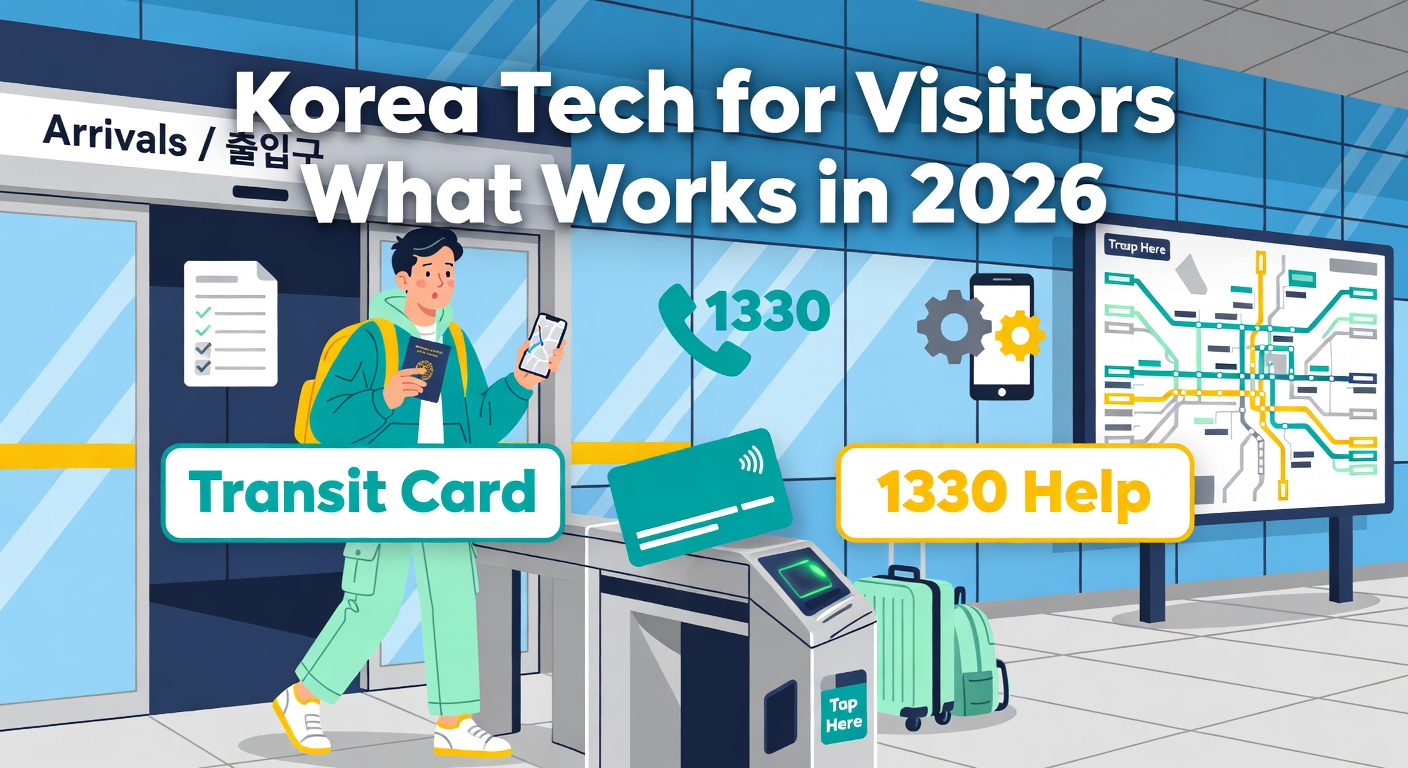
The e-Arrival Card: Skip the Paper Form at Immigration
Since February 24, 2025, Korea has offered an electronic arrival card (e-Arrival card) that lets you submit your immigration declaration online up to three days before landing. If you have used arrival cards in other Asian countries, the concept is familiar — passport details, flight info, accommodation address, purpose of visit.
The part many people find confusing is whether the paper form is still available. As of early 2026, both the electronic and paper versions are accepted. The official parallel period ran through the end of 2025. Whether paper forms are still distributed beyond that cutoff may vary by airport and entry point — check the official immigration site for current status before your trip. The safe approach: complete the e-Arrival card online before your flight and treat any paper option as a last resort, not your plan A.
🔗 e-Arrival Card Official Site
One common mistake is waiting until you are on the plane or in the immigration line to start filling it out. The form asks for your Korean accommodation address in detail, and fumbling through a hotel booking confirmation on airplane Wi-Fi is not ideal. Have your passport, flight number, and hotel address ready at least the day before departure.
The eligibility rules can also vary by nationality and entry type, so check the official immigration site before assuming you qualify. For most standard tourist entries, the system works smoothly — but if your situation is unusual (transit passengers, certain visa categories), confirm directly with the Korean embassy or the e-Arrival card FAQ page.
🔗 Korea Immigration Service — e-Arrival Card Info
That takes care of getting into the country. But once you are through immigration, you will need a way to get around — and that is where transit payment gets interesting.
Getting Around: Transit Cards vs. Open-Loop Payments
Korea's public transit is famously efficient, but paying for it as a foreigner has historically been a pain point. The traditional solution is buying a T-money card — a rechargeable transit card available at convenience stores and subway station kiosks — and loading it with cash or at a top-up machine.
This still works everywhere in Korea and remains the most reliable option in 2026. A T-money card costs around 2,500 won, and you can load it with whatever amount you need. It works on subways, buses, and even some taxis and convenience stores across the country.
The newer development is Seoul's push toward open-loop payment, which would let foreign credit cards (Visa, Mastercard) tap directly at transit gates without needing a separate card. Seoul announced a phased rollout starting October 2025. However — and this is where many visitors get tripped up by outdated blog posts — this is not yet fully available on all lines and all card types. Coverage is expanding, but "expanding" means some gates, some lines, some card networks.
The practical advice: buy a T-money card when you arrive, and treat open-loop tap as a bonus if it happens to work at your station. If you are only visiting Seoul and your card network is supported, you might get lucky at certain gates. But do not plan your entire trip around it, especially if you are heading to Busan, Jeju, or smaller cities where open-loop has not arrived.
🔗 Seoul Metro Open-Loop Payment Announcement
For taxis, most accept credit cards, but having a T-money card or cash as backup avoids awkward situations with older taxis or drivers who prefer not to swipe cards. Navigation apps like Kakao Map and Naver Map both offer taxi-hailing features, though using them brings us to the next major friction point.
Apps and Identity Verification: The Biggest Digital Barrier
This is where most foreigners hit a wall, and it catches even experienced travelers off guard. Korea runs on apps — for food delivery, taxi hailing, shopping, banking, even convenience store pickups. But a surprising number of these apps require Korean phone number verification (본인인증, bon-in-injeung) to create an account or complete a purchase.
The verification process typically works like this: the app sends an SMS to a Korean mobile number, and the number must be registered under your name with a Korean carrier. A foreign SIM, a prepaid tourist SIM, or a roaming number usually will not pass this step. Even if the app has an English interface and shows prices in won, the payment flow may dead-end at the identity verification screen.
This is the single most common complaint from foreigners trying to use Korean digital services. Based on Reddit threads and travel forums, people frequently download Baemin (배달의민족, Korea's biggest food delivery app), get excited about the English interface, and then cannot place an order because their foreign number fails verification.
What actually works for foreigners
The situation is improving. Baemin has been expanding foreign card support through global payment services like WeChat Pay and Alipay+. Some services offer guest checkout that bypasses the full verification process. And newer platforms specifically targeting tourists are designed from the ground up to work with foreign cards and phone numbers — search app stores for current tourist-friendly options, as this space shifts frequently.
Here is a realistic breakdown of your options:
| Service Type | Korean Phone Needed? | Foreign Card Accepted? | English Support |
|---|---|---|---|
| Baemin (standard) | Usually yes for full account | Expanding (WeChat Pay, Alipay+) | Yes (app interface) |
| Coupang Eats | Yes for signup | Limited | Partial |
| Tourist-focused platforms | No | Yes (Visa, Mastercard) | Yes |
| Kakao Taxi | Yes | Some international cards | Yes |
| Naver Map / Kakao Map | No (for navigation) | N/A (free app) | Yes |
The policies around foreign card acceptance and verification requirements change frequently — sometimes monthly — so treat this table as a starting point, not a permanent reference. Before downloading any app, check its most recent app store reviews from other foreigners for the latest status.
For food, your fallback is always simple: walk into a restaurant. Korea has an enormous density of excellent places to eat, and most accept credit cards at the counter. Delivery is convenient, but it is not the only way to eat well.
1330: Korea's 24/7 Tourism Helpline
If something goes wrong — you are lost, you cannot communicate with a taxi driver, you need directions to a hospital, or you just cannot figure out how a kiosk works — call 1330. This is Korea Tourism Organization's official helpline, staffed 24 hours a day, 365 days a year, with support in English, Japanese, Chinese, and Korean.
The number works from any phone in Korea, including your roaming phone. Dial 1330 from anywhere in Korea — the number works nationwide on any phone. If you want to reach a region-specific tourism desk (for example, Seoul-specific enquiries while you are in Busan), prefixing the local area code (e.g., 02-1330) may route you more precisely, though the standard 1330 line handles most questions regardless of where you are calling from. The operators can help with directions, translation for taxi drivers, tourist attraction information, and general travel questions.
A common misconception is treating 1330 as an emergency number. It is not. For medical emergencies, fire, or crime, call 119 (fire/ambulance) or 112 (police). The 1330 line is specifically for tourism support and interpretation — extremely useful, but not a substitute for emergency services.
🔗 Ministry of Culture — 1330 Tourism Hotline
At major airports and tourist areas, you will also find multilingual digital information kiosks and tourist information centers that can connect you to 1330 or provide in-person help. Having your hotel name and address written in Korean (ask the front desk to write it down, or screenshot it from Naver Map) makes every interaction — with taxi drivers, 1330 operators, and passersby — dramatically easier.
Before You Leave for the Airport: Your Prep Checklist
Most of the frustration foreigners experience in Korea comes from not knowing what to set up before arrival. The country's digital infrastructure is excellent once you are inside the system, but getting inside the system is the hard part. Ten minutes of preparation at home saves hours of confusion on the ground.
One thing worth noting: Korea's tourist infrastructure has been scaling rapidly. The government reported record-breaking inbound tourist numbers in 2025 — exceeding 18 million visitors according to Ministry of Culture projections — and the policy direction is clearly toward making things easier for foreigners. Open-loop transit, multilingual apps, and streamlined e-Arrival processing are all part of that push. The experience will likely keep improving, but right now, in 2026, you still need to prepare for some friction.
When Things Go Wrong: Emergency vs. Help Numbers
Korea has clear, separate channels for different types of trouble. Mixing them up wastes time when you need help most.
119 — Fire, ambulance, medical emergency. This is the number to call if someone is hurt, there is a fire, or you need an ambulance. Some operators speak basic English, but communication can be limited.
112 — Police. For crime, theft, or safety threats.
1330 — Tourism help and interpretation. Not for emergencies, but invaluable for everything else: directions, translation, complaints about tourist services, transit confusion.
In a medical emergency, call 119 first — some operators have basic English capability. If communication is still breaking down, a second call to 1330 can connect you with an interpreter who can relay information to emergency services. Always reach 119 before anything else.
Wrapping Up
Korea's everyday technology is built for speed and convenience — but it was built for residents with Korean phone numbers and Korean bank accounts. As a visitor, you are working against the grain of that system in certain areas, especially app-based services and identity verification.
The good news: the four things that matter most are all manageable with basic preparation. Complete the e-Arrival card before your flight. Buy a T-money card at the airport. Save 1330 in your phone. And do not assume any app will work until you have checked whether it accepts your foreign number and card.
Korea is actively working to close the gap between its advanced digital infrastructure and foreign visitor accessibility. Each year brings meaningful improvements. But the smartest move is still the simplest one: prepare for the friction points before you board the plane, so you can focus on enjoying the trip once you arrive.
Frequently Asked Questions
Q. Can I use my foreign credit card on Korean subway?
Seoul has been rolling out open-loop payment that accepts some Visa and Mastercard cards directly at subway gates since late 2025. However, coverage is not yet universal across all lines and stations. Your safest option is still buying a T-money card at any convenience store, which works on all transit nationwide.
Q. Do I need a Korean phone number to use delivery apps in Korea?
Most major Korean delivery apps like Baemin and Coupang Eats require Korean phone number verification for full account creation. Some are expanding foreign payment options through services like Alipay+ and WeChat Pay. Tourist-focused ordering platforms that accept foreign cards and numbers do exist as alternatives, though their restaurant coverage may be more limited.
Q. What is the 1330 number in Korea and when should I call it?
The 1330 line is Korea Tourism Organization's 24-hour helpline offering tourist information, directions, and real-time interpretation in English, Japanese, Chinese, and Korean. Call it when you need help communicating, finding a location, or resolving a travel-related issue. It is not an emergency number — for medical emergencies call 119, and for police call 112.
Q. How do I fill out the Korea e-Arrival card online?
Visit the official e-Arrival card website up to three days before your flight to Korea. You will need your passport details, flight information, and Korean accommodation address. After submitting, you can skip the paper arrival card at immigration. Both electronic and paper forms are currently accepted, so the paper version works as a backup if needed.
Q. Why can't I verify my identity on Korean apps with a foreign phone number?
Korea's identity verification system (본인인증) is tied to Korean mobile carriers and resident registration. A foreign SIM, roaming number, or tourist SIM typically will not pass this check because it is not registered under your name with a Korean telecom provider. This affects app signups, purchases, and some online services — it is the single biggest digital barrier for foreigners in Korea.

IT Engineer · Content Creator
Practical guides based on official sources — simple and actionable.
View all posts →