Korea AI Robots — Your Guide to What's Actually Happening in 2026
If you've been following tech news out of Korea lately, you've probably noticed a surge of headlines about humanoid robots, massive government investments, and new AI regulations. It's hard to tell which developments matter for people actually living or working here — and which are just hype.
This article breaks down the confirmed facts: how much Korea is investing in AI robotics, what the M.AX Alliance actually does, when humanoid robots are expected to reach production, and what Korea's new AI law means in practice. Whether you're in the tech industry, running a business in Korea, or simply curious about where this country is heading, here's what's real, what's planned, and what's still uncertain.
Korea's $71 Billion AI Robot Bet — The Numbers Behind the Headlines
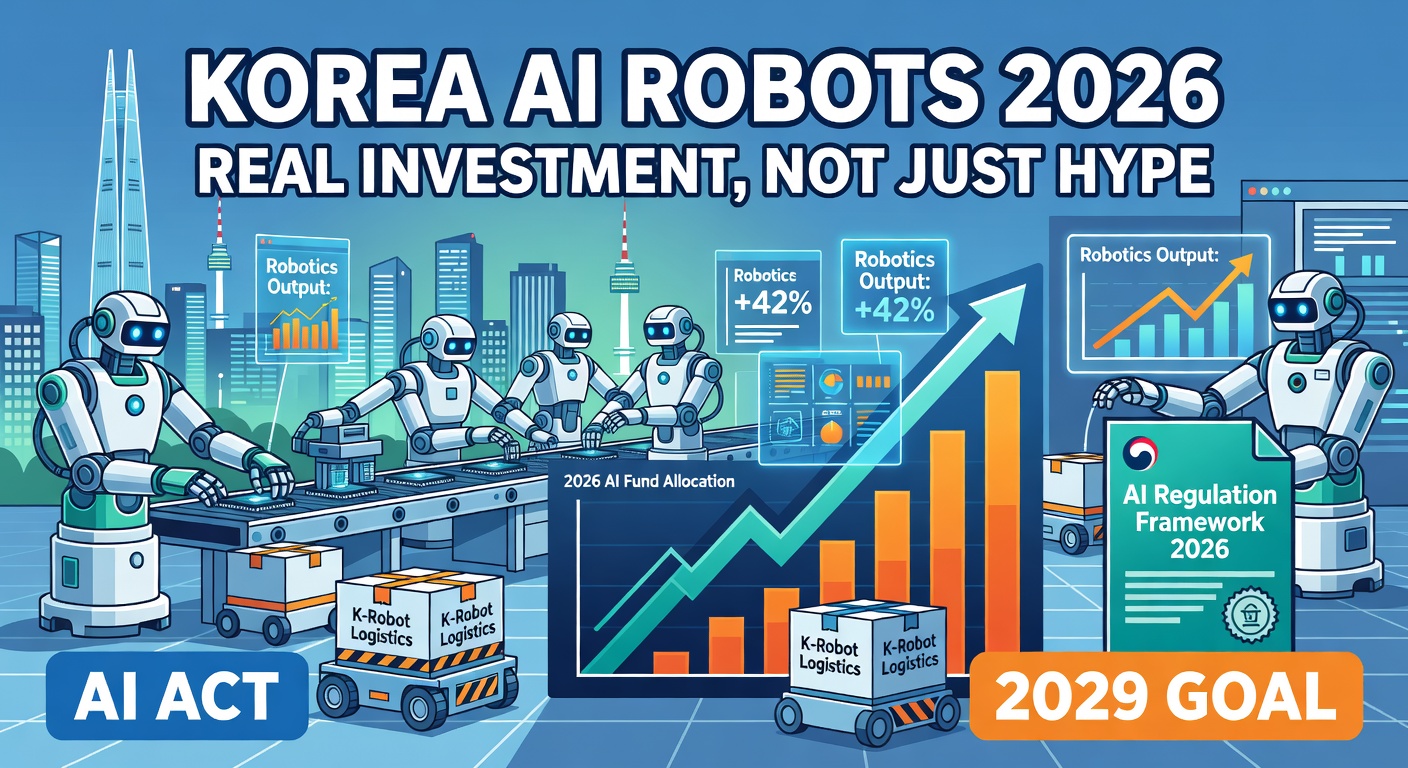
The Korean government announced a five-year blueprint in 2025 to invest roughly 100 trillion won (about $71 billion) into AI and robotics, branding the initiative an "AI super-innovation economy." That's not a single check being written — it's a multi-year commitment spanning public R&D funding, private-sector partnerships, and regulatory infrastructure.
According to IDC estimates cited by InvestKorea, Korea's AI market stood at approximately 34.3 trillion won in 2025 and is projected to reach around 44.6 trillion won by 2027. These are estimates, not guarantees, but they give a sense of the trajectory.
🔗 South Korea's AI Blueprint — Dig.watch
Many people find the investment figure confusing because it sounds like a single government budget line. In reality, it combines public spending, corporate commitments, and projected private investment. The government sets the direction and contributes a portion, but companies like Hyundai, Samsung, and LG are expected to carry much of the spending through their own R&D.
The practical effect for people in Korea is that AI-related jobs, research positions, and startup funding are expanding significantly. If you're working in manufacturing, logistics, or IT services here, your industry is likely to see AI integration efforts accelerate over the next few years.
The M.AX Alliance — Who's Building Korea's Robot Future
In September 2025, the Ministry of Trade, Industry and Energy launched the Manufacturing AI Transformation (M.AX) Alliance, pulling together Korea's biggest industrial players — Hyundai Motor Group, Samsung Electronics, LG Electronics, POSCO — alongside smaller AI and robotics startups.
🔗 Korea Times — Humanoid Robot Production Goals
The alliance has set three milestone targets:
- 2028: Build a foundation AI model specifically for humanoid robots
- 2029: Begin mass production of industrial humanoid robots — at least 1,000 units per year
- 2030: Launch commercially viable end-to-end autonomous vehicles
These targets are ambitious, and it's worth understanding what they actually mean. The 2029 humanoid robot goal is focused on industrial and manufacturing applications — factory floors, warehouses, hazardous environments. Consumer-facing household robots are a much longer timeline, despite what some headlines suggest.
Hyundai's role is particularly notable. The company established a dedicated robotics innovation hub in Korea, building on its acquisition of Boston Dynamics. At CES 2026, over 800 Korean companies showcased AI, robotics, and autonomous vehicle technologies — making Korea one of the largest national presences at the event.
What makes the M.AX Alliance distinctive is its structure. Rather than relying solely on government funding or pure private-sector competition, Korea is trying a hybrid approach: large conglomerates (chaebol) work alongside startups and public research institutes under a shared roadmap. Whether this produces results faster than the American startup-driven model or China's state-directed approach remains to be seen.
How Korea Compares to the US and China in AI Robotics
If you're following the global AI robotics race, Korea's strategy sits in a distinct middle ground. Here's how the three major players compare:
| Factor | South Korea | United States | China |
|---|---|---|---|
| Investment model | Government-chaebol alliance + startups | Private-sector led (Google, Tesla, startups) | State-directed + massive private funding |
| Estimated AI/robot investment | ~$71B over 5 years | Distributed across private firms | ~$145B+ in AI/robot funding |
| Humanoid robot focus | Manufacturing & logistics first | Broad (consumer + industrial) | Large-scale industrial deployment |
| AI regulation | Comprehensive AI Act (Jan 2026) | Gradual, state-by-state | Sector-specific regulations |
| Key players | Hyundai, Samsung, LG, POSCO | Tesla, Google, OpenAI ecosystem | Huawei, DJI, state labs |
| Mass production target | 2029 (1,000+ units/year) | Varies by company | Already scaling select models |
Korea's advantage lies in its tight coordination between government policy and corporate execution. The disadvantage, as some analysts have pointed out, is that Korea's humanoid robot policy has been slower to materialize compared to China's rapid scaling. A January 2026 report from the Seoul Economic Daily noted that Korea's specific humanoid policies still lagged behind the pace of global competitors.
🔗 Seoul Economic Daily — Humanoid Robot Policy Analysis
For expats and international professionals working in Korea, the practical takeaway is that robotics-related career opportunities are growing — but the real job market impact is concentrated in manufacturing hubs and corporate R&D centers, not evenly distributed across the economy.
Korea's AI Act — The World's First Comprehensive AI Law
One development that affects everyone — not just the tech sector — is Korea's Artificial Intelligence Act, which took effect in January 2026. Korea became one of the first countries globally to implement a comprehensive legal framework specifically for AI systems, including robots.
The law establishes safety, transparency, and oversight requirements for high-performance ("frontier") AI systems. Companies deploying AI-powered robots must now conduct safety assessments, provide technical explanations of how their systems work, and disclose when content is generated by AI.
What often trips people up is assuming the law is fully detailed and final. The broad framework is in place, but specific implementing rules — especially for humanoid robots and physical AI systems — are still being developed. KIRIA (the Korea Institute of Robot Industry Advancement) is conducting research on humanoid-specific regulations, and additional guidelines are expected over the coming months and years.
🔗 MSIT — National AI Strategy Policy Directions
The regulation isn't designed to slow innovation — Korea's government has been explicit about wanting to lead the global AI race. Instead, the AI Act is positioned as a trust-building measure, meant to give both domestic users and international partners confidence that Korean AI products meet safety standards.
What You'll Actually See — AI Robots in Daily Life in Korea
Beyond the policy announcements and investment figures, the question most people have is straightforward: when will I actually interact with AI robots in Korea?
Some of that future is already here. Delivery robots have been operating in select apartment complexes and university campuses. Robot baristas serve coffee in a growing number of cafes across Seoul. Autonomous logistics robots move packages in major warehouse facilities. These aren't humanoids — they're specialized machines designed for single tasks.
The next wave, expected over the next two to four years, will likely include more visible service robots in public spaces: airports, hotels, hospitals, and large commercial buildings. Smart city projects in Sejong, Songdo, and other planned urban areas are integrating AI systems into traffic management, energy distribution, and public services.
The gap between "AI robot" as used in policy documents and what most people actually picture is worth spelling out. Policy discussions focus on industrial automation — factory robots, warehouse systems, construction aids. The humanoid robots walking around serving you dinner are still further out, and their deployment depends heavily on cost reductions and regulatory clarity that hasn't fully materialized yet.
For travelers and short-term visitors, the most likely robot encounters in 2026 are at Incheon Airport (automated information kiosks, cleaning robots), major hotel chains, and tech-forward cafes in Gangnam and Hongdae. These interactions tend to be novelty experiences rather than essential services — for now.
The Road Ahead — What's Confirmed vs. What's Projected
It's useful to separate what Korea has already done from what remains a target on a roadmap.
Confirmed and in effect:
- The five-year AI investment blueprint is official policy (announced August 2025)
- The AI Act is law (effective January 2026)
- The M.AX Alliance is operational with signed corporate participants
- CES 2026 showcased working prototypes from Korean companies
- Delivery and service robots are deployed in limited commercial settings
Targeted but not yet realized:
- 1,000+ humanoid robots per year in mass production (target: 2029)
- End-to-end autonomous vehicle commercialization (target: 2030)
- Humanoid AI foundation model completion (target: 2028)
- 100 trillion won in additional value creation through M.AX (target: 2030)
The distinction matters. Policy roadmaps in Korea are taken seriously and often backed by real funding, but they're not guaranteed outcomes. Economic conditions, global supply chains, and technological breakthroughs (or setbacks) all affect whether these milestones land on schedule. Based on previous Korean tech policy cycles, some targets will be met or exceeded, and others will be quietly pushed back.
Frequently Asked Questions
Q. When will humanoid robots be available in Korea?
Korea's M.AX Alliance targets mass production of industrial humanoid robots starting in 2029, with at least 1,000 units per year. These are designed for factories and warehouses, not consumer use. Home or personal-assistant humanoid robots are further out, with no confirmed commercial timeline yet.
Q. How much is Korea investing in AI and robotics?
The Korean government announced a five-year plan to invest approximately 100 trillion won (around $71 billion) in AI and robotics, starting from 2025. This figure combines public R&D funding and expected private-sector investment from major corporations like Hyundai, Samsung, and LG.
Q. What is Korea's AI Act and how does it affect robots?
Korea's Artificial Intelligence Act took effect in January 2026, making it one of the world's first comprehensive AI laws. It requires safety assessments, transparency disclosures, and oversight for high-performance AI systems, including AI-powered robots. Specific humanoid robot regulations are still being developed.
Q. Can I see robots in Seoul right now?
Yes, though in limited settings. Robot baristas operate in several Seoul cafes, delivery robots serve select apartment complexes, and Incheon Airport uses automated kiosks and cleaning robots. These are task-specific machines, not the humanoid robots featured in policy announcements.
Q. How does Korea's AI robot strategy compare to China and the US?
Korea uses a hybrid model combining government policy with chaebol (large conglomerate) partnerships and startup support. China invests more in absolute dollar terms with stronger state direction, while the US relies more on private-sector innovation. Korea's distinct advantage is tight government-corporate coordination, but some analysts note its humanoid-specific policies have been slower to develop than competitors'.
Recommended Posts
- Scan and Pay Utility Bills on Mobile — A Beginner's Step-by-Step Guide
- Korea Tech for Visitors: A Beginner's Guide to Daily Digital Life
- AI Travel Korea: Your Guide to Smarter Trip Planning in 2026
- Food Delivery Apps in Korea — A Tourist's Step-by-Step Guide (2026)
- Zero-Click AI in Korea: How Naver and Kakao Are Changing Search in 2026
IT Engineer · Content Creator
Practical guides based on official sources — simple and actionable.
View all posts →