Jeonse vs Monthly Rent in Korea — Compared for Foreigners (2026)
You found an apartment you like in Seoul, and the real estate agent just handed you two options: a jeonse contract asking for ₩200 million upfront, or a wolse contract at ₩500,000 per month with a ₩10 million deposit. If those numbers feel like they come from completely different planets, you are not alone. Most foreigners arriving in Korea hit this exact wall within their first week of apartment hunting.
This article breaks down how jeonse (전세) and monthly rent (월세, wolse) actually work in 2026, what each one costs when you do the real math, and which option makes more sense depending on how long you plan to stay and how much cash you have available. By the end, you will know which contract type fits your situation — and what paperwork traps to watch out for.
What Jeonse and Wolse Actually Mean
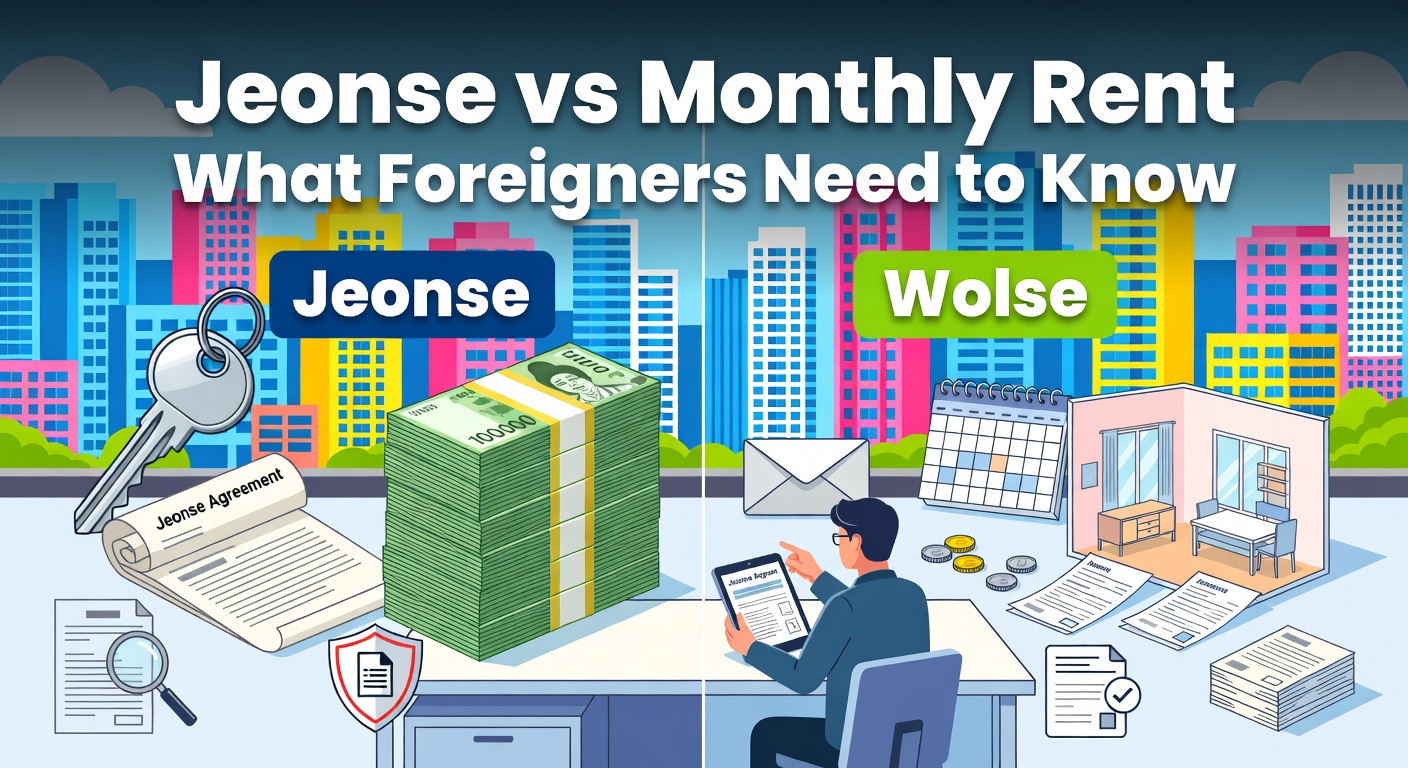
Jeonse (전세) is a rental system unique to Korea. Instead of paying monthly rent, you hand the landlord a large lump-sum deposit — often tens or hundreds of millions of won. You live in the place for two years (the standard lease term), and when the contract ends, the landlord returns your full deposit. No monthly payments at all during that time.
Wolse (월세) is closer to what most countries call "renting." You pay a smaller deposit upfront, plus a fixed monthly rent. The deposit is typically between ₩5 million and ₩30 million depending on the area and apartment size, and monthly rent ranges widely — ₩400,000 to ₩1,500,000 or more in Seoul.
There is also a hybrid called banjeonse (반전세), where you put down a mid-sized deposit and pay a reduced monthly rent. Many people find the line between wolse and banjeonse confusing because agents sometimes label them interchangeably. The key distinction is the deposit-to-rent ratio: if the deposit is large enough that the monthly payment drops significantly, it is effectively banjeonse.
The Korean rental market has been shifting steadily toward wolse in recent years. According to Economy Chosun (January 2026), the overall trend is a contraction of jeonse transactions and expansion of monthly rent, driven by rising interest rates and the fallout from jeonse fraud cases.
The Real Cost Comparison — Numbers That Might Surprise You
Here is where most foreigners get tripped up: jeonse looks "free" because there is no monthly rent, but it is not actually free. That large deposit sitting with your landlord could be earning interest if it were in your bank account instead.
With interest rates at 4–5% in early 2026, a ₩300 million jeonse deposit represents roughly ₩1 million per month in opportunity cost — money you could have earned. A Naver Premium analysis from March 2026 demonstrated that when you factor in this opportunity cost, the gap between jeonse and wolse narrows considerably, and in some cases wolse comes out cheaper over a two-year period.
| Factor | Jeonse (전세) | Wolse (월세) |
|---|---|---|
| Upfront deposit | ₩100M–₩500M+ (varies by area) | ₩5M–₩30M typical |
| Monthly payment | ₩0 | ₩400K–₩1.5M+ |
| Hidden cost | Opportunity cost (4–5% of deposit/year) | Maintenance + utilities on top |
| Standard lease | 2 years (renewable) | 1–2 years (flexible) |
| Deposit return risk | High — landlord must return full sum | Low — smaller amount at stake |
| Flexibility to leave | Difficult mid-contract | Easier to negotiate early exit |
| Best for | Long-term, large capital available | Short-term, limited upfront cash |
One thing many people overlook: with wolse, you also need to budget for gwanlibi (관리비) — monthly maintenance fees — plus utilities. These can add ₩100,000–₩300,000 per month on top of your rent, especially in newer officetel buildings. Always ask for the total monthly cost before signing.
The Jeonse Fraud Problem — Why This Matters for Foreigners
This is not a theoretical risk. As of January 2026, Korea's Ministry of Land, Infrastructure and Transport reported 36,449 confirmed jeonse fraud victims nationwide, with about 60% of cases concentrated in the Seoul metropolitan area.
Jeonse fraud (전세사기) typically happens when a landlord — or someone posing as one — collects large deposits from multiple tenants, then cannot or will not return the money when leases end. The landlord may have used your deposit to pay off their own debts or to fund other property purchases. When the whole structure collapses, tenants are left fighting to recover deposits that may no longer exist.
🔗 2026 Jeonse fraud prevention measures — details
For foreigners, there is an added complication: the government's deposit return guarantee fee subsidy program (up to ₩400,000 for deposits under ₩300 million) currently excludes foreign nationals and overseas Koreans from eligibility. This means you can still purchase the insurance, but you will not receive the government subsidy to offset the premium cost.
If you are going the jeonse route, deposit return guarantee insurance is not optional — treat it as mandatory. The cost is worth it when the alternative is losing your entire deposit.
2026 Legal Changes You Should Know About
Korea's Housing Lease Protection Act (주택임대차보호법) has gone through significant revisions that took effect in 2025–2026. Here are the changes that directly affect your rental contract:
Contract renewal rights have expanded. Tenants now have the right to request one contract renewal (previously established under the "Tenant 3 Laws"), with legislative discussions underway to extend this to two renewals — potentially allowing up to six years of tenancy. However, this expansion has not been finalized into law as of March 2026, so confirm the current status before assuming you have two renewals available.
Rent increase caps remain at 5%. Under the Housing Lease Protection Act (주택임대차보호법), when you renew a contract, the landlord cannot raise the jeonse deposit or monthly rent by more than 5% from the previous contract terms.
Lease reporting requirements are stricter. Both jeonse and wolse contracts now require formal reporting. Failing to register your contract properly can weaken your legal standing if a dispute arises later.
Move-in registration (전입신고) now grants immediate tenant protection. Under the 2026 anti-fraud measures, the protective effect of registering your address kicks in right away rather than from the following day, as was previously the case.
🔗 2026 Housing Lease Protection Act — full summary
In practice, the most common mistake is skipping the move-in registration step entirely. Many people assume the contract itself is enough. It is not. Without 전입신고 (jeonse or wolse), you lose your legal priority claim to the deposit if the property is sold or foreclosed.
The Foreigner-Specific Hurdles
Signing a lease in Korea as a foreigner comes with a few extra friction points that locals do not face.
Documentation. Your contract will need your Alien Registration Card (ARC) number or passport number. Errors in this field — a surprisingly common problem — can create issues with registration and legal protections. Double-check every digit.
Jeonse loans are harder to get. Korean banks offer jeonse loans to help tenants fund the deposit, but approval for foreigners is significantly more difficult. You will generally need a stable visa type (E-7, F-2, F-5, F-6), proof of income in Korea, and often a Korean co-signer. Many foreigners discover this only after finding an apartment, which creates a scramble.
Language barriers in contracts. Standard Korean lease agreements are entirely in Korean. Getting a notarized translation or having a bilingual friend review the contract is strongly recommended. Real estate agents are legally required to explain contract terms, but the depth and quality of that explanation varies wildly.
Public housing options exist but are limited. Long-term foreign residents on specific visa types may qualify for public rental housing through LH (Korea Land & Housing Corporation) or SH (Seoul Housing & Communities Corporation). Eligibility typically requires being a non-homeowning household head with income below 70% of the urban worker average. These programs are worth investigating if you qualify, but slots are competitive.
🔗 Foreigner jeonse contract guide in Korea
Which One Should You Choose?
There is no universal answer, but your situation will point you in a clear direction.
If you are on a one-year contract or a short-term visa, wolse is almost always the practical choice. The risk-reward calculation for jeonse simply does not work for short stays — the effort of securing the deposit, the fraud risk, and the difficulty of recovering your money if you need to leave early all tilt heavily against it.
For foreigners planning to stay long-term with stable income, jeonse can genuinely save you money across multiple two-year lease cycles. But that calculation only works if you protect yourself: get deposit return guarantee insurance, verify the property deed, and register your lease properly.
Before You Sign — Your Protection Checklist
Regardless of which contract type you choose, there are non-negotiable steps to protect yourself.
Skipping even one of these steps — especially the move-in registration and confirmed date stamp — can leave you legally unprotected if something goes wrong. These are not bureaucratic formalities; they are the foundation of your tenant rights in Korea.
Conclusion
The jeonse-vs-wolse decision ultimately comes down to three things: how much cash you have available, how long you are staying, and how much risk you are comfortable with. Wolse is simpler, more flexible, and involves far less money at stake — making it the safer default for most foreigners. Jeonse can be financially advantageous over longer stays, but only if you take every precaution against deposit loss.
Whatever you choose, the three steps that matter most are the same: register your move-in address, get a confirmed date stamp on your contract, and calculate the full cost before you commit. Everything else is negotiable.
Frequently Asked Questions
Q. Is jeonse cheaper than monthly rent in Korea?
Not always. While jeonse eliminates monthly payments, the opportunity cost of tying up a large deposit at current interest rates (4–5%) can equal or exceed what you would pay in monthly rent. For a ₩300 million deposit, that hidden cost is roughly ₩1 million per month. Whether jeonse saves you money depends on the specific deposit amount, interest rates, and how long you stay.
Q. Can foreigners get a jeonse loan in Korea?
It is possible but significantly harder than for Korean citizens. You will typically need a long-term visa (E-7, F-2, F-5, or F-6), proof of stable income in Korea, and sometimes a Korean co-signer. Loan conditions vary by bank, so checking with multiple lenders is recommended before committing to a jeonse contract.
Q. What happens if my jeonse landlord does not return my deposit?
If you have deposit return guarantee insurance (보증금반환보증) through HUG, HF, or SGI, the insurer will pay you and then pursue the landlord. Without insurance, you would need to go through legal proceedings, which can take months or years and may not result in full recovery — especially if the landlord is insolvent. This is why the insurance is considered essential.
Q. Do I need to register my wolse contract with the government?
Yes. Under the strengthened 2026 lease reporting rules, both jeonse and wolse contracts must be formally reported. Beyond legal compliance, registering your contract and completing move-in registration (전입신고) at your local community center is what establishes your legal priority as a tenant. Without it, you lose critical protections.
Q. What is banjeonse and when does it make sense?
Banjeonse (반전세) is a hybrid where you pay a moderately large deposit plus a reduced monthly rent. It makes sense when you have some savings but not enough for a full jeonse deposit, and you want to lower your monthly outflow. It also reduces your fraud risk compared to full jeonse since less money is tied up with the landlord. The exact deposit-to-rent ratio varies and is negotiable with the landlord.

IT Engineer · Content Creator
Practical guides based on official sources — simple and actionable.
View all posts →