Cheap Housing in Seoul Near Subway — Expat Options Compared
You just got your visa approved, your start date is six weeks away, and now you're staring at Seoul apartment listings wondering how anyone affords to live here. The deposit numbers look like typos — ₩300,000,000 for a studio? — and the monthly rent on that "affordable" officetel near Gangnam Station is more than you budgeted for everything. If you're a single expat trying to land somewhere close to a subway station without draining your savings on day one, the standard Korean rental market was not designed with you in mind.
The reality is that Seoul's housing market operates on a system built around massive upfront deposits, long-term contracts, and a network of local knowledge that takes years to navigate. But there are genuinely affordable options — you just need to know which ones exist, what they actually cost once you add up all the fees, and which pitfalls to watch for before signing anything.
Why "Cheap" in Seoul Means Something Different Than You Think
Seoul's dominant rental system is jeonse (전세), where tenants pay a lump-sum deposit — often ₩450 million to ₩600 million (roughly $330,000–$440,000) for a small apartment — instead of monthly rent. The landlord invests that money and returns it when you leave. For a single expat on a teaching or corporate contract, jeonse is essentially off the table.
Even the monthly rent option, called wolse (월세), typically requires a deposit of ₩10–30 million ($7,300–$22,000) plus ₩700,000–₩1,200,000 per month for a basic one-room near a subway station. That's before utilities and management fees.
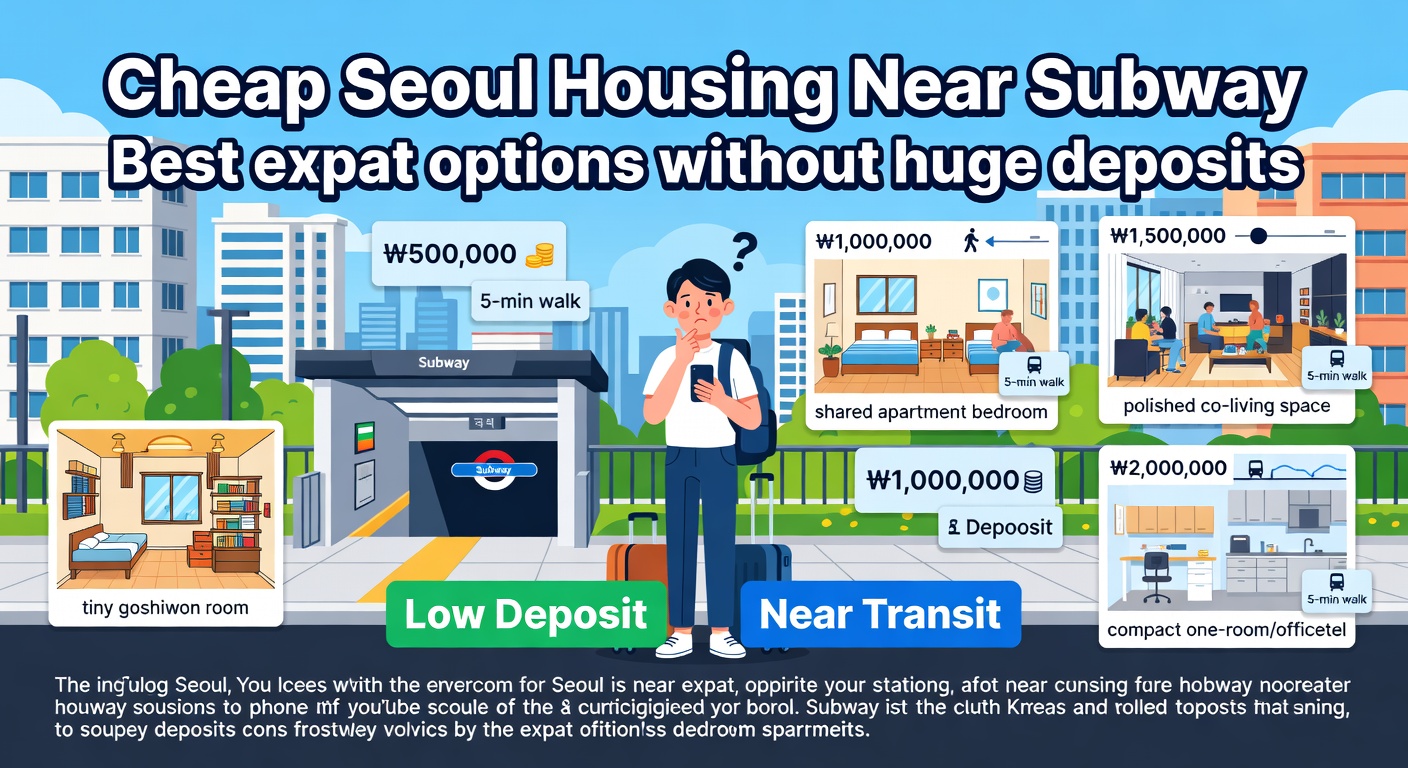
So when expats search for "cheap housing in Seoul," they're usually looking at a completely different tier of the market: goshiwon, share houses, and co-living spaces that operate outside the traditional deposit-heavy system.
A common point of confusion: many people assume wolse deposits are negotiable down to zero. They're sometimes flexible, but offering a lower deposit almost always means higher monthly rent. The total cost over your lease often works out similarly either way.
Average monthly rent near subway stations in Seoul (₩10,000 units, 2025–2026 estimates)
Goshiwon: The Ultra-Budget Starting Point
A goshiwon (고시원) is a micro-room — originally built for students cramming for civil service exams — that has become the go-to for expats who need a roof immediately with almost no money upfront. Rooms typically run ₩300,000–₩500,000 per month with deposits of ₩0–₩100,000. Many are located within a five-minute walk of subway stations, particularly around university neighborhoods.
What you get: a bed, a desk, maybe a tiny window, shared bathrooms, and often free rice and kimchi in a communal kitchen. Rooms range from about 3 to 5 square meters — barely enough to stretch your arms out.
What trips people up most: the price posted outside often includes utilities and Wi-Fi, but not always. Some goshiwon charge separately for electricity if you run an air conditioner, or add a cleaning fee. Ask for the total monthly cost in writing before committing.
Goshiwon work best as a landing pad — somewhere to stay for your first one to three months while you get your Alien Registration Card (ARC), open a bank account, and search for longer-term housing in person. Living in one long-term is doable but tough. Noise carries through thin walls, privacy is minimal, and the lack of personal cooking space gets old fast.
If you're considering a goshiwon near a specific subway line, look at stations along Line 2 (the loop line that connects most major university and business districts) or Line 6 through Itaewon and the Yonsei/Hongdae university belt, where competition keeps prices lower.
Share Houses: Better Value, More Compromise
Share houses sit one tier above goshiwon in both price and livability. Monthly rent typically falls between ₩400,000 and ₩650,000, with deposits of one to two months' rent. You get a private bedroom in a furnished apartment, sharing the kitchen, bathroom, and living area with two to five housemates.
The appeal for expats goes beyond cost. Companies like Borderless House specifically match Korean and international tenants, creating a built-in social network. Others cater to specific demographics — women-only houses, digital nomad–friendly spaces with coworking areas, or houses near specific subway lines.
Based on reviews, the biggest pain point is housemate compatibility. Cleaning schedules, noise levels, and guest policies vary wildly between houses. The operator's management quality matters enormously — a well-run share house with clear rules and responsive staff is a completely different experience from one where the landlord just split an apartment and walked away.
Before signing, visit in person. Check water pressure, confirm laundry access, and ask current residents how responsive the management is when something breaks. The listing photos will always show the place at its best — the Tuesday-night reality may differ.
The jump to share houses is where many expats find their sweet spot between affordability and livability, especially if they plan to stay six months or longer.
Co-living Spaces: The Expat-Friendly Premium Option
Branded co-living has expanded rapidly across Seoul's subway-adjacent neighborhoods since 2025. These are professionally managed residences offering private or semi-private rooms with hotel-like amenities: regular cleaning, community events, coworking lounges, and — critically for newcomers — English-speaking staff and bilingual lease agreements.
Monthly costs range from ₩700,000 to ₩1,100,000, with deposits of ₩0–₩500,000. That puts co-living in the same price range as a basic one-room apartment, but without the ₩10–30 million deposit or the hassle of setting up utilities, buying furniture, and negotiating with a Korean-speaking landlord.
Where most people get confused: co-living looks expensive compared to a goshiwon, but when you factor in that one-room apartments charge separate management fees (₩50,000–₩150,000/month), plus utilities (₩100,000–₩200,000 in winter), plus furniture and internet setup costs, the gap narrows significantly. Some co-living rents are genuinely all-inclusive; others are not. Get the full breakdown before comparing.
Co-living makes the most sense for expats who value convenience and community over pure cost savings, or those whose employers provide a housing allowance that doesn't quite cover a traditional apartment deposit.
One-Rooms and Officetels: When You Want Your Own Space
If your budget stretches to ₩700,000–₩1,200,000 per month and you can handle a deposit of ₩10–30 million, a one-room (원룸) or officetel (오피스텔) near a subway station gives you full independence: your own bathroom, kitchen, and front door.
The distinction between the two is blurry but generally meaningful. One-rooms are residential units in smaller buildings — often older, cheaper, and more basic. Officetels are mixed-use buildings (office + hotel) with newer construction, better security systems, and higher management fees.
A common mistake among expats: not accounting for gwanlibi (관리비, management/maintenance fees). An officetel advertised at ₩900,000/month might charge another ₩100,000–₩300,000 in management fees covering building maintenance, elevator service, security, and sometimes heating. Your actual monthly housing cost could be 15–30% higher than the listed rent.
For foreigners, the contract process adds layers of complexity. You'll need your ARC, proof of income or employment, and in some cases a Korean guarantor. Some landlords simply refuse foreign tenants — it happens more often than most newcomers expect, and no amount of documentation will change a firm no. Working with a real estate agent (부동산, budongsan) near your target station helps, but agents earn commission from the landlord and may not always advocate for your interests.
| Housing Type | Monthly Rent | Deposit | Min. Stay | Best For |
|---|---|---|---|---|
| Goshiwon | ₩300K–500K | ₩0–100K | 1 month | Ultra-low budget, short stays |
| Share House | ₩400K–650K | 1–2 months | 3–6 months | Social expats, medium stays |
| Co-living | ₩700K–1.1M | ₩0–500K | 1–3 months | Convenience-first, English support |
| One-room | ₩700K–1.2M | ₩10M–30M | 12 months | Long-term, independence |
| Officetel | ₩900K–1.5M+ | ₩10M–30M+ | 12 months | Professionals, employer-backed |
Seoul's Youth Housing Program: A Potential Wild Card
In March 2026, Seoul Metropolitan Government announced plans to supply 74,000 youth housing units by 2030, including 16,000 shared youth apartments and 10,000 units specifically near subway stations. These units are priced roughly 10–20% below market rate, with lower deposits than private landlords typically require.
The catch: eligibility for foreigners is uncertain and varies by program. Some youth housing programs have opened limited slots to international students or young foreign workers, but this is not guaranteed across all programs. Each announcement (공고, gonggo) carries its own eligibility criteria around age (usually 19–39), income level, and residency status. Assuming you qualify because you've seen one program accept foreigners would be a mistake — always check the specific announcement on the Seoul Metropolitan Government, SH Corporation, or LH Corporation websites.
As part of the same March 2026 package, the city also introduced a "half-wolse" (반월세) contract model aimed at reducing monthly rent by approximately ₩100,000, with expanded deposit return guarantee subsidies. These policy shifts signal that Seoul recognizes its affordability problem, but the pipeline of units won't meaningfully change the market for another few years.
If you're planning a longer stay and meet the age requirements, bookmarking the SH and LH announcement pages is worth the five minutes it takes.
How to Actually Find a Place: Step by Step
Knowing your options means nothing if you can't navigate the search process. Here's how expats who've done this successfully tend to approach it.
Set Your Numbers First
Before opening a single listing, write down three figures: your maximum monthly payment (rent + management fees + utilities), your maximum deposit, and your minimum acceptable commute to work or school. Everything else is noise until these are clear.
For context: if your total monthly housing budget is under ₩500,000, you're looking at goshiwon or budget share houses. Between ₩500,000 and ₩800,000, share houses and some co-living options open up. Above ₩800,000 with a deposit of ₩10 million+, one-rooms become realistic.
Pick Your Subway Lines, Not Neighborhoods
Rather than fixating on a neighborhood name, identify the subway line(s) that connect to your workplace or university. Then look at stations along those lines where housing is cheaper — usually a few stops away from the major hubs.
On Line 2, stations east of Gangnam (like Jamsil or Seongsu) or west toward Hapjeong and Sinchon often have lower rents than the Gangnam–Seocho corridor. Line 6 through Itaewon, Noksapyeong, and Sangsu runs through neighborhoods with high expat density and solid share house inventory. Line 7 and Line 9 offer more affordable pockets as you move toward the outer reaches of the city.
Use the Right Platforms
Korean platforms like Naver Real Estate (네이버 부동산), Zigbang (직방), and Dabang (다방) have the widest inventory but require basic Korean to navigate effectively. Filter by station name, set the rent range, and look for listings tagged 월세 (monthly rent).
For goshiwon, share houses, and co-living, English-friendly platforms and communities tend to be more useful. Expat Facebook groups, Reddit's r/korea and r/Living_in_Korea, and specialized housing platforms that cater to foreigners aggregate options that won't always show up on mainstream Korean apps.
Visit Before You Sign — No Exceptions
This is where most expat housing horror stories begin. Photos lie. A "5-minute walk from the station" might mean 5 minutes for someone who knows the shortcut through the alley, or 15 minutes with a suitcase via the actual pedestrian route. Basement and semi-basement (반지하, banjiha) rooms photograph fine but flood during summer monsoons and grow mold through winter.
Walk the route from the station to the front door. Visit at night to check noise levels and street lighting. Turn on the faucets. Open the windows. These 30 minutes will save you months of regret.
The Contract Checklist Every Expat Needs
Korean lease contracts are legally binding even when signed in Korean only, and many landlords won't provide an English version unless you specifically request one. Here's what to verify before you put ink to paper.
For standard one-room or officetel leases: confirm the landlord's identity matches the property registration (등기부등본, deunggibu deungbon). Check for existing liens or mortgages on the property. Register your move-in date (전입신고, jeonip singo) at your local community center (주민센터) to protect your deposit — this is one of the most overlooked steps among foreigners, and skipping it significantly weakens your legal standing if a deposit dispute arises.
For goshiwon and share houses: verify the operator's business registration. Confirm exactly what's included in the price — management fees, utilities, internet, cleaning. Ask about the refund policy and early termination penalties in writing. Some goshiwon keep your entire deposit if you leave before the agreed period, even if that period was never formally discussed.
You'll need your passport, ARC (or application receipt), and a Korean bank account for most contracts. Some landlords require proof of employment or a Korean guarantor. If a landlord refuses to provide any written agreement at all, walk away — this happens occasionally with goshiwon operators and is a serious red flag.
What "Near the Subway" Actually Means
The Korean real estate concept of yeoksegwon (역세권, subway-adjacent) generally means within a 5–10 minute walk of a station — roughly 250 to 500 meters. But there's no legal definition, and listings stretch this aggressively. A place advertised as "3 minutes from Hapjeong Station" might measure that from the station's least convenient exit, ignoring the underground walk to the platform itself.
Many people find this confusing because Korean distance estimates for real estate almost never account for hills, stairs, or the time it takes to get from the station entrance down to the platform level. A station like Yaksu (Lines 3 and 6) has a significant underground transfer distance that adds 5+ minutes to your commute even if you live right above the exit.
Use map apps to check the walking route, and add 3–5 minutes of buffer for getting through turnstiles and reaching the platform during rush hour.
Making Your Decision
The cheapest option isn't always the best value. A goshiwon at ₩350,000/month near a station that requires two transfers to your workplace could cost you more in time, transport fees, and mental energy than a share house at ₩550,000 on a direct line. Run the full math: rent + management fees + utilities + transportation + the cost of eating out if you have no kitchen.
If you're arriving in Seoul for the first time, the most practical path is to book a goshiwon or short-term co-living space for your first month, get your ARC and bank account set up, then search for longer-term housing in person. Trying to lock down the perfect apartment from overseas, sight unseen, is how expats end up overpaying or stuck in a place that looked nothing like the photos.
Seoul's rental market is tight, prices have been climbing since late 2025, and the definition of "affordable" keeps shifting upward. But for a single expat willing to start small and search strategically, there are genuine options within walking distance of a subway station at every budget level.
Frequently Asked Questions
Q. Can I rent an apartment in Seoul without a Korean guarantor?
Yes, but your options narrow. Most goshiwon and share houses don't require a guarantor. For one-rooms and officetels, some landlords accept a larger deposit in lieu of a guarantor, while others require one regardless. Having a Korean employer willing to vouch for you significantly improves your chances.
Q. How much deposit do I need for the cheapest housing in Seoul?
Goshiwon typically require ₩0–₩100,000, making them the lowest barrier to entry. Share houses usually ask for one to two months' rent as deposit (₩400,000–₩1,300,000). One-rooms and officetels jump to ₩10 million or more, which is why most budget-conscious expats start with the first two options.
Q. Is it safe to live in a goshiwon in Seoul as a foreigner?
Goshiwon are generally safe in terms of personal security — most have keypad entry and are located in busy neighborhoods near universities and subway stations. The main concerns are fire safety (check for extinguishers and two exits), thin walls offering little privacy, and limited ventilation in windowless rooms. Visiting before committing is essential.
Q. Can foreigners apply for Seoul's public youth housing near subway stations?
Some programs have accepted foreign students or young workers, but eligibility varies by announcement. Each public housing program through Seoul, SH Corporation, or LH Corporation sets its own criteria for age, income, and residency status. Check the specific program's notice rather than assuming foreigners are included or excluded by default.
Q. What is the real total monthly cost of living in a Seoul officetel near a subway station?
Expect the advertised rent (₩900,000–₩1,500,000) plus management fees (₩100,000–₩300,000) plus utilities (₩80,000–₩200,000 depending on season). The actual monthly cost typically runs 15–30% higher than the listed rent. Always ask for a breakdown of gwanlibi and utility estimates before signing a lease.

IT Engineer · Content Creator
Practical guides based on official sources — simple and actionable.
View all posts →