You arrive in Korea feeling prepared, then the real friction starts. A hospital intake form is in Korean, the subway staff member is kind but rushed, and the food delivery app keeps sending push notifications you only half understand. This is exactly where AI tools that Korea users actually need stop feeling optional and start feeling practical.
What makes this especially interesting now is that AI in Korea is no longer limited to private apps on your phone. Seoul Asan Medical Center has launched an integrated medical platform for international patients that combines registration, medical data submission, pre-consultation, telemedicine, and AI-powered translation of patient data. Yonhap has reported that the Korea Tourism Organization's "Yeohaeng Kkokkok" service includes an AI planner that recommends routes based on schedule and preferences. And on the consumer side, translation tools such as Google Translate, Microsoft Translator, DeepL, iTranslate, Notta, and the Korea-focused Papago have become part of everyday problem-solving for foreigners in Korea.
That doesn't mean Korea suddenly has one perfect AI super app for housing, banking, transport, healthcare, and shopping. It means something more realistic: if you build the right stack, AI can remove a surprising amount of daily stress. That's the part worth getting right before we talk about specific tools.
Why AI Feels So Useful in Korea Right Now
Korea is highly digitized, but that doesn't automatically make it foreigner-friendly. Many daily systems are fast, app-based, and efficient for locals, yet they can still feel opaque if your Korean is limited or if you don't know the social and administrative shortcuts.
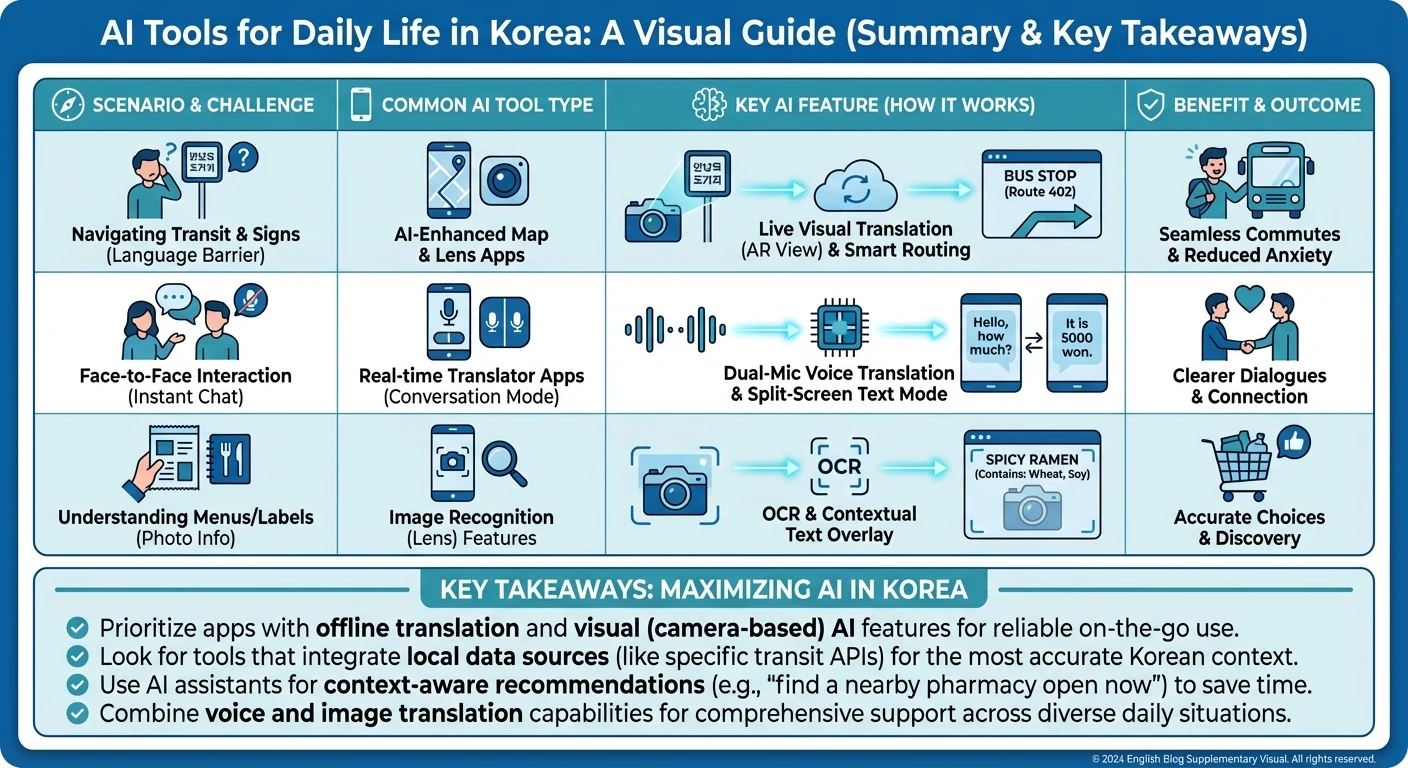
That's exactly where AI helps. It doesn't replace local apps like Naver Map, KakaoMap, Kakao T, or Korail. Instead, it acts as a translation layer, planning layer, and explanation layer on top of them. In practical terms, that means you can take a screenshot of a notice, ask an assistant to explain the tone of a landlord message, summarize a clinic document, or turn a rough itinerary into something you can actually use.
Korea is also starting to embed AI directly into public-facing services. The Seoul Metropolitan Government expanded Seoul Metro's AI-assisted multilingual communication system to 11 stations in 13 languages in 2024, making face-to-face help easier in major tourist and transit areas. Korail then opened a Travel Center at Seoul Station on October 23, 2025 with AI translation support for foreign rail users. Seoul tourism services have also been moving toward generative AI-based itinerary help, rather than static FAQ pages.
For foreigners, the shift is straightforward: you no longer need perfect Korean to handle every small task alone. You just need a better system for when to use AI, when to use official channels, and when to stop guessing and ask a human.
That distinction matters most when language is the daily bottleneck, so translation is the best place to start.
Build Your Korea AI Stack Around Translation
If you only install one category of tool before living or traveling in Korea, make it translation. Not because translation apps are perfect, but because they unlock every other part of life here.
Give each app a job
The biggest mistake is expecting one app to do everything. A better approach is to assign roles.
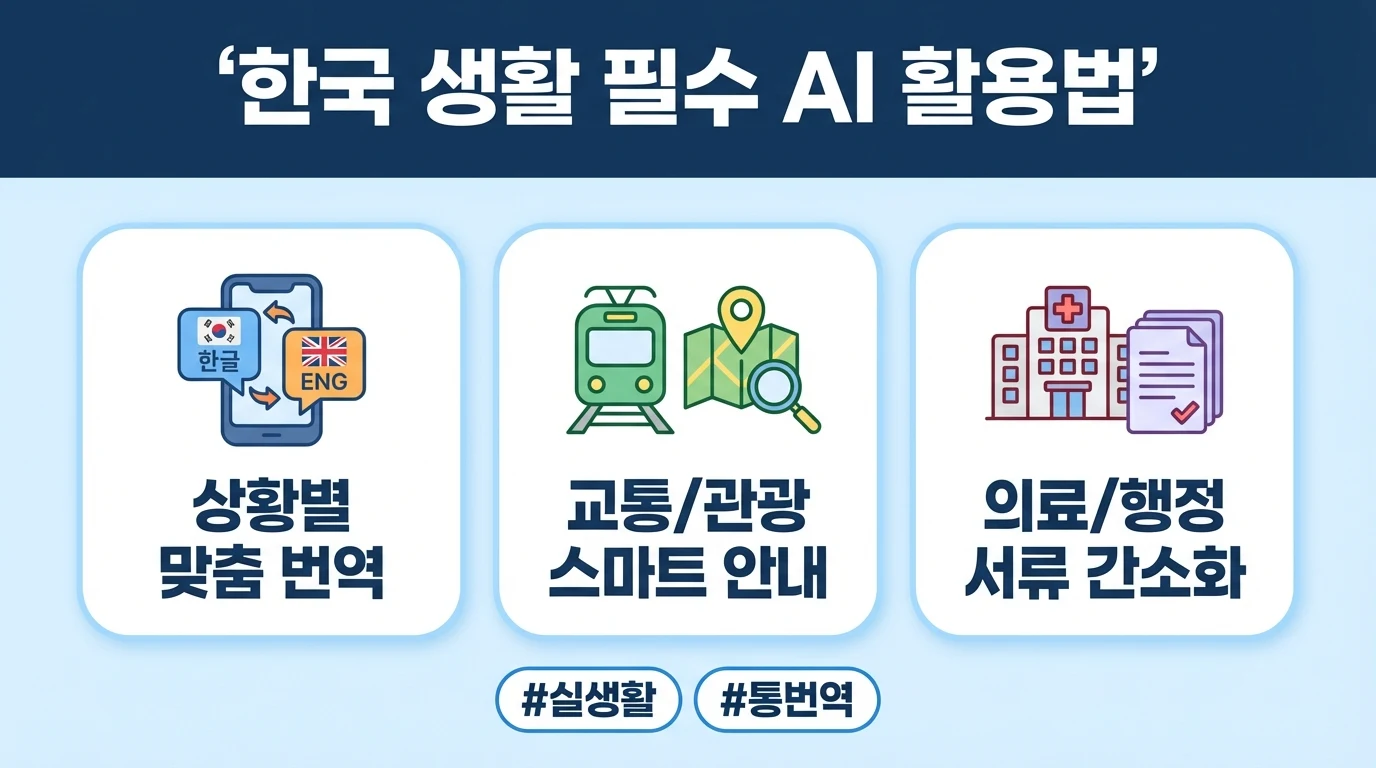
Papago is often the first app people keep for Korea because it's optimized for Korean and tends to handle short everyday phrases, menu text, and casual expressions well. It's especially useful for camera translation, chat-style phrasing, and quick back-and-forth conversation.
Google Translate is helpful when you need broader language coverage, especially if your first language isn't among the most common ones supported in Korean public services. It's also convenient for image translation and live conversation features.
DeepL is often stronger when tone and sentence flow matter — such as in emails, applications, or slightly more formal writing. It won't always win on Korean-specific nuance, but it tends to produce more natural English.
Microsoft Translator is useful if you already work in the Microsoft ecosystem or want another live conversation option.
Notta is worth considering for a different reason: it's less about quick phrases and more about transcription plus translation. That matters in Korea when you're dealing with recorded meetings, long voice notes, or spoken explanations you want converted into searchable text.
In practice, many expats and travelers do best with a two-layer setup: one Korea-first translator like Papago, and one broader assistant like Google Translate, DeepL, or Notta depending on the task. Once you stop treating translation as a single tool, it becomes much more reliable.
Automate the small language problems
This is where AI starts to feel like the smart living Korea users actually notice.
Set up a notes page on your phone with prompts you can reuse:
- "Translate this into polite Korean for a clinic receptionist."
- "Explain this Korean message in simple English and tell me if I need to respond today."
- "Turn this subway notice into a one-sentence summary."
- "Translate this menu and flag ingredients that may contain pork, shellfish, or peanuts."
- "Rewrite this in natural, respectful Korean — not too casual."
That sounds basic, but it saves real time because Korea generates a lot of short, high-context communication: apartment notices, school messages, beauty clinic reminders, package alerts, building management texts, and reservation confirmations.
You should also use OCR and screenshot workflows aggressively. Korea still relies heavily on image-based text, PDFs, and HWP/HWPX files — the local document formats often used by government agencies and institutions. Being able to capture text from an image and drop it into a translator or assistant is often faster than searching for an English version that may not exist.
The goal isn't perfect Korean. The goal is to reduce hesitation — because once hesitation drops, transport and travel become much easier too.
Use AI to Travel Around Korea With Less Friction
For short-term visitors, AI is most visible when planning a trip. For long-term residents, it matters more during transit, navigation, and sudden schedule changes.
Subway and rail help is getting more practical
One of the most useful public examples is Seoul Metro's multilingual AI conversation system. According to the Seoul Metropolitan Government, the service was expanded in March 2024 to 11 high-traffic stations and supports 13 languages, including English, Japanese, Chinese, Vietnamese, Thai, Malay, Indonesian, Spanish, French, German, Arabic, Russian, and Korean.
That matters because station help in Korea often breaks down at exactly the wrong moment: last-train questions, transfer confusion, luggage problems, or airport-connection stress. At stations such as Myeong-dong, Hongik University, Itaewon, City Hall, or Gimpo International Airport Station, the system can close that awkward gap between "I know where I want to go" and "I can't explain it fast enough."
Korail is moving in the same direction. On October 23, 2025, Korail opened a Travel Center at Seoul Station equipped with AI translation and tourist information functions for foreign users. That's especially relevant if you're buying or changing KTX tickets, asking about rail passes, or connecting a train journey with local sightseeing.
Use Korean data, not just global AI guesses
This is where a lot of travel content goes wrong. A general AI assistant can build you an itinerary, but if it isn't grounded in Korean tourism data, it may return closed businesses, poor routing, or generic recommendations.
That's why the Korea Tourism Organization's work matters. Yonhap reported that KTO's "Yeohaeng Kkokkok" includes an "AI Kkokkok Planner" that recommends routes based on the user's schedule and preferences. Even if you don't use that exact service, the broader lesson holds: AI works better in Korea when it's layered on top of Korean transport and tourism data, not detached from it.
The official VISITKOREA English site also offers trip-planning functions, and Seoul tourism services have been testing generative AI itinerary support through the Visit Seoul ecosystem. Yonhap reported in February 2025 that the Visit Seoul app introduced a pilot "travel planner" service using generative AI and its tourism database, with answers available in Korean, English, Chinese, and Japanese.
The smartest workflow is usually this:
- Use a Korea-based tourism or transit platform for real options.
- Use AI to compare, simplify, translate, and personalize those options.
- Double-check opening hours, ticket policies, and holiday schedules before paying.
That gives you something far more useful than a generic "3 days in Seoul" plan — and it leads directly into the part of Korea life where language matters even more: healthcare.
Where AI Helps Most in Korean Healthcare
Healthcare is one of the clearest examples of AI for foreigners Korea actually needs, because the gap isn't only linguistic. It's also emotional, procedural, and time-sensitive.
AI can lower the barrier before the appointment
Seoul Asan Medical Center's international platform is significant because it shows what practical healthcare AI looks like. According to the hospital, international patients can move through registration, medical-data upload, pre-consultation, and telemedicine within a single system, with AI functions helping translate uploaded patient data and integrate it into the hospital's information system.
For a foreigner in Korea, that matters in two ways.
First, it reduces the paperwork shock. You may have scans, blood test results, medication lists, or symptom descriptions from another country, and those are rarely organized the way a Korean hospital expects. AI-assisted intake helps bridge that gap.
Second, it improves the quality of the first conversation. Even when hospitals provide coordinators or interpreters, appointments move quickly. If your symptoms, timeline, and questions are already translated and organized, the visit becomes far less chaotic.
You can apply the same approach before seeing any doctor:
- Turn a messy note into a clear symptom timeline
- Translate drug names and dosage history
- Summarize previous test results into a one-page brief
- Prepare short questions in both Korean and English
- Convert voice notes into text before the visit
This is one of the most valuable uses of AI in Korea because it saves mental energy when you're already stressed.
Healthcare is also where you should trust AI the least
This needs to be said plainly. Use AI to prepare, not to diagnose.
Translation can miss nuance. Medical summaries can flatten important details. Even good AI output can sound more confident than it should. If you're dealing with treatment decisions, consent forms, surgery, cancer care, pregnancy concerns, or anything urgent, use AI as a drafting tool and confirm everything with qualified medical staff.
If you have chest pain, difficulty breathing, severe bleeding, stroke-like symptoms, or other emergency signs, skip the app and seek emergency help immediately. The point of AI is to reduce friction, not delay care.
That same principle applies outside hospitals too — not every difficult task in Korea should be automated.
Turn General AI Into a Korea Life Assistant
The most effective AI setup in Korea isn't only about official services. It's about using a general assistant for the messy, repetitive parts of daily life that local apps don't explain well.
The best use case is "translation plus context"
A Korea-specific app may tell you what buttons exist. AI helps you understand what they mean in context.
That is useful for:
- Building management notices
- Delivery delays
- Reservation rules
- Refund policies
- Gym, clinic, and beauty appointment messages
- University or language-school announcements
- Restaurant booking instructions
- Short-term rental house manuals
It's also useful for drafting polite Korean. Korea has strong social tone differences, and the wrong level of directness can come across as rude even when the grammar is correct. AI is helpful when you ask it to rewrite something in polite but simple Korean for a landlord, receptionist, coworker, or neighbor.
For longer-term residents, you can go further and automate routines:
- Summarize your spending categories from Korean card notifications
- Turn a week of Korean messages into a simple to-do list
- Translate product reviews before buying
- Compare telecom or gym plans in plain English
- Convert class schedules or work rosters into calendar entries
This is what automated tasks in Korea really looks like on the ground. It's rarely glamorous. It's mostly small tasks that stop piling up.
Prompts that actually work in Korea
For better results, make your prompts specific.
- "Translate this Korean notice and tell me the action deadline."
- "Write a polite Korean reply asking if there is an English form."
- "Summarize this hospital instruction sheet in plain English."
- "Compare these two mobile plans and explain any hidden conditions."
- "Turn this trip plan into a realistic one-day Seoul route using the subway."
- "Explain this delivery message and tell me if I missed the package."
- "Rewrite my question in respectful Korean for an older person."
Those are much stronger than asking an AI to "help with Korea." The more specific the task, the more useful the output.
Still, there are hard limits — and those limits matter if you want smart living rather than reckless convenience.
What AI Still Cannot Fix in Korea
It's easy to overestimate how seamless this all is. Korea has made visible progress, but the gaps are real.
The first gap is coverage. Translation, tourism, and some healthcare services are improving faster than housing, finance, legal support, or immigration workflows. There's still no widely adopted AI platform that cleanly handles every part of foreigner life.
The second gap is language inequality. English, Chinese, Japanese, and a few other major languages tend to get the best support. If your primary language is less common, you may still need a second translation layer or human assistance.
The third gap is privacy. Uploading passports, medical records, addresses, bank screenshots, or location-heavy travel logs means handing over sensitive data. Read privacy policies before using AI-heavy services, especially in healthcare and finance.
The fourth gap is accuracy in high-stakes situations. AI can help you organize a rental contract, but it shouldn't be your final legal review. It can translate a hospital instruction sheet, but it shouldn't be your only medical explanation. It can summarize a public-service page, but official rules still take precedence.
Keep those boundaries clear, and AI becomes much more useful and much less risky. That's why a simple starter setup usually beats a complicated one.
A Practical Starter Setup for Foreigners in Korea
If you want a realistic setup you can build in one afternoon, start here.
- Install Papago for Korean-first translation and camera use.
- Keep Google Translate or DeepL as a second option for broader language support or smoother English output.
- Use Notta if you regularly deal with meetings, voice notes, interviews, or longer spoken explanations.
- Save a notes page with reusable prompts for clinics, landlords, travel, and customer service.
- Use official Korean platforms for final details: VISITKOREA, Korail, local transit apps, and hospital websites.
- Treat AI as a helper for translation, summarizing, and drafting — not as your final authority on legal, financial, or medical decisions.
If you're only visiting Korea for a week, this setup helps you move around with less stress. If you live here long term, it becomes a quiet productivity system that saves time almost every day.
And that's probably the most honest way to think about AI tools Korea foreigners can use right now — not as a futuristic lifestyle fantasy, but as a practical layer that makes Korea easier to read, easier to navigate, and a little less tiring to manage.
Sources
- Asan Medical Center: integrated medical platform for international patients
- Seoul Metropolitan Government: Seoul Metro AI translation expanded to 11 stations and 13 languages
- Korail: Seoul Station Travel Center with AI translation support
- VISITKOREA official English site
- Yonhap: KTO "Yeohaeng Kkokkok" AI planner
- Yonhap: Visit Seoul generative AI travel planner pilot
- Seoul open government record: 2025 Visit Seoul generative AI chatbot operation contract
- Notta Help Center: translation features
Service details can change. The sources above were checked on March 11, 2026.